

What Are the Key Features of an ONDC Seller Platform?
Learn the key features of an ONDC Seller Platform, including catalog management, logistics, payments, analytics, inventory, and multi-store support. Discover how to choose the right ONDC platform to grow your business in 2026.

India's e-commerce industry is growing rapidly. According to industry estimates, the Indian e-commerce market is expected to cross USD 400 billion by 2025 and USD 500 billion by 2027. At the same time, the Open Network for Digital Commerce (ONDC) is creating new opportunities for businesses to sell online without depending on a single marketplace.
The numbers show how quickly ONDC is expanding:
- 350+ million cumulative transactions completed by late 2025
- 7.6 lakh+ sellers onboarded by April 2025
- Available in 800+ cities, including Tier 2 and Tier 3 markets
- ONDC aims to increase daily transactions by 10 times by the end of 2026
Unlike traditional marketplaces, ONDC is an open network. A seller can list products once and make them available across multiple buyer applications such as Paytm, Magicpin, Pincode and other ONDC-compatible apps.
However, businesses cannot connect directly to ONDC. They need an ONDC Seller Platform, also known as a Seller Network Participant (SNP). This platform manages product listings, inventory, orders, payments, logistics and reporting.
Choosing the right ONDC Seller Platform is one of the most important decisions for businesses planning to sell on ONDC.
What is an ONDC Seller Platform?
An ONDC Seller Platform is the technology that connects your business with the ONDC network.
Think of ONDC as a highway. Buyer apps are the vehicles that customers use to shop. Your seller platform is the gateway that helps your products travel across the network.
It allows you to:
- Upload your product catalog
- Manage inventory
- Receive orders
- Process payments
- Track deliveries
- Monitor business performance
Unlike Amazon or Flipkart, where the marketplace controls most of the selling experience, ONDC allows sellers to choose their preferred technology platform.
10 Key Features Every ONDC Seller Platform Should Have
1. ONDC Protocol Compliance
The platform should support the latest ONDC protocol and automatically update whenever new versions are released.
It should also connect your products to multiple buyer applications instead of only one.
2. Easy Catalog Management
Your catalog directly impacts product visibility.
A good seller platform should support:
- Bulk product uploads
- Product variants
- Multiple product images
- Rich product attributes
- Real-time catalog updates
- Catalog quality score
A complete catalog generally performs better in buyer app search results.
3. Real-Time Order Management
Orders can arrive from multiple buyer apps at the same time.
Your platform should provide:
- One dashboard for all orders
- Instant notifications
- Order tracking
- Bulk order actions
- Return and refund management
- Cancellation workflow
This helps businesses process orders faster and reduce errors.
4. Inventory Management
Inventory accuracy is critical on ONDC.
A good platform should offer:
- Live inventory synchronization
- Low-stock alerts
- Multi-warehouse inventory
- Buffer stock settings
- Inventory history
Industry benchmarks suggest sellers should aim for:
- 95%+ order fulfilment rate
- Less than 3% cancellation rate
- 98%+ logistics fill rate
5. Logistics Integration
ONDC allows sellers to choose logistics partners.
Look for platforms that support:
- Multiple courier partners
- Automatic courier selection
- Hyperlocal delivery
- Real-time shipment tracking
- Pickup scheduling
- Delivery performance reports
According to industry reports, ONDC logistics orders increased from 35,000 in April 2024 to over 2 million orders in February 2025, showing the rapid growth of logistics on the network.
6. Payment & Settlement Management
A reliable seller platform should provide complete payment transparency.
Important features include:
- Settlement dashboard
- GST invoices
- Reconciliation reports
- Deduction details
- Expected settlement dates
ONDC generally follows T+1 to T+2 settlement cycles, helping sellers receive payments faster than many traditional marketplaces.
7. Multi-Store Management
Businesses operating from multiple warehouses or cities need centralized management.
The platform should support:
- Multiple stores
- Warehouse-based inventory
- Location-wise order routing
- Staff permissions
- Consolidated reports
This is especially useful for FMCG brands, distributors and enterprise sellers.
8. Marketing & Promotion Tools
Unlike marketplaces, ONDC does not run promotions for individual sellers.
Your seller platform should include:
- Coupons
- Discount campaigns
- Loyalty programs
- Customer engagement tools
- WhatsApp sharing
- Affiliate or influencer links
These features help increase repeat purchases and improve customer retention.
9. Analytics & Business Reports
Data helps businesses make better decisions.
Your dashboard should provide insights into:
- Revenue
- Orders
- Buyer app performance
- Inventory
- Delivery performance
- Customer locations
- Product performance
These reports help identify top-selling products and improve operations.
10. Easy Onboarding & Seller Support
The best platforms simplify onboarding.
Look for:
- Guided KYC
- GST verification
- Product listing assistance
- Training resources
- WhatsApp or phone support
- Dedicated account managers
Many businesses can go live within 30 minutes when the onboarding process is well designed.
Why These Features Matter
Choosing the wrong seller platform can result in:
- Poor product visibility
- Inventory mismatches
- Delayed deliveries
- Payment issues
- Higher cancellation rates
- Lost sales
On the other hand, a feature-rich platform improves customer experience and helps businesses scale efficiently on ONDC.
Why Costbo is a Strong Choice
Costbo is built as a complete ONDC commerce platform for D2C brands, MSMEs, wholesalers and enterprises.
Key capabilities include:
- ONDC Protocol 1.2+ compliance
- Multi-buyer app integration
- Multi-store management
- Smart logistics routing
- Real-time inventory
- Settlement dashboard
- Catalog optimization tools
- Advanced analytics
- WhatsApp support
- Quick onboarding
Businesses can manage their complete ONDC operations from a single dashboard while reaching customers across multiple buyer applications.
Conclusion
ONDC is transforming digital commerce in India by giving sellers more flexibility, lower platform costs and access to multiple buyer applications through a single network.
However, success on ONDC depends on choosing the right seller platform.
Before making a decision, ensure your platform offers strong catalog management, real-time inventory, logistics integration, payment transparency, analytics, multi-store support and reliable customer support.
If you are planning to sell on ONDC in 2026, investing in the right seller platform today will help you grow faster as the network continues to expand across India.
Frequently Asked Questions
1. What is an ONDC Seller Platform?
An ONDC Seller Platform is a technology platform that connects businesses to the ONDC network and helps manage products, orders, inventory, logistics and payments.
2. Can I sell on ONDC without a seller platform?
No. Every seller needs an ONDC-compatible Seller Network Participant (SNP) to connect with the ONDC network.
3. What features should I look for in an ONDC Seller Platform?
Look for catalog management, inventory management, logistics integration, payment tracking, analytics, multi-store support and ONDC protocol compliance.
4. Is ONDC suitable for MSMEs?
Yes. ONDC is designed to help MSMEs, D2C brands, retailers and wholesalers reach customers across India with lower selling costs.
5. Does ONDC provide logistics?
ONDC supports multiple logistics providers through integrated seller platforms.
6. How quickly can I start selling on ONDC?
Many businesses can complete onboarding and publish their first products within 30 minutes, depending on documentation and catalog readiness.
7. Can wholesalers use ONDC?
Yes. ONDC is increasingly being adopted by wholesalers and distributors to reach business buyers across India.
8. Why is catalog quality important?
A complete catalog with accurate titles, descriptions, images and attributes improves discoverability across ONDC buyer apps.
References
- ONDC Official – https://ondc.org
- ONDC Open Data – https://opendata.ondc.org
- DPIIT, Government of India – https://dpiit.gov.in
- Costbo Research – https://costbo.com
- eShipz Research – Empowering Brands through Smart Logistics in the ONDC Era
- Inc42 ONDC Industry Reports
Related post
.png)
.png)
How Multiple Buyer Apps Access the Same Sellers on ONDC (Network Effect Explained Simply)
.png)
ONDC Buyer App vs Amazon/Flipkart App: What's Actually Different for Shoppers
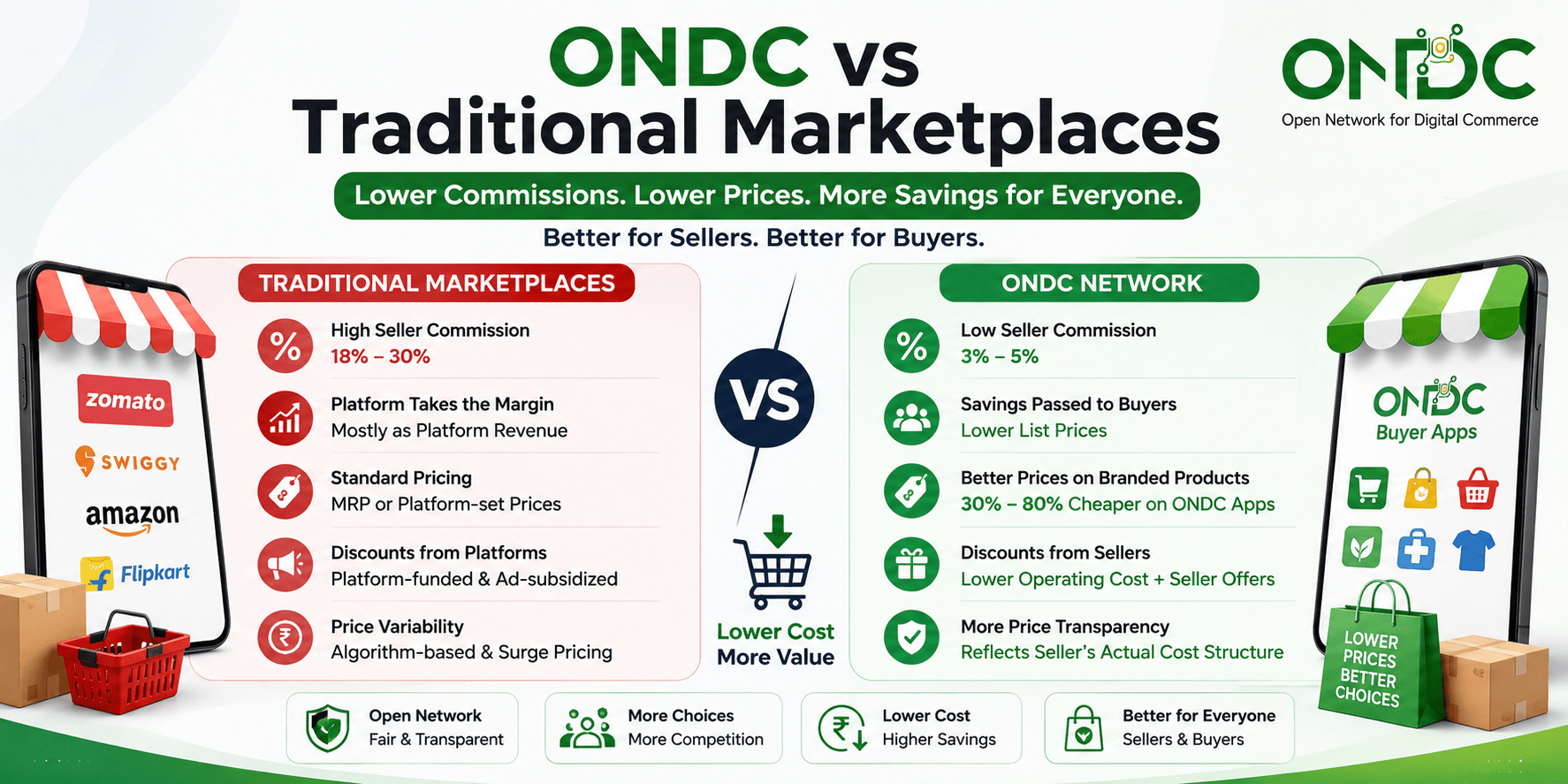
ONDC Discounts & Offers: How Buyers Save More Than on Traditional Marketplaces
Sounds like COSTBO might be the right choice for your business?
Get started by registering your business today! If you have any questions, we're here to help. Our team will reach out to you with detailed information about our offerings, product features, and a demo