

ONDC Buyer App vs Amazon/Flipkart App: What's Actually Different for Shoppers
Compare ONDC buyer apps with Amazon and Flipkart to understand pricing, sellers, delivery, app experience, returns, and dispute resolution for shoppers.
.png)
Quick Answer
The core difference is structural: Amazon and Flipkart are single companies that control the entire buying experience end to end, while an ONDC buyer app is one of 30+ independent apps connected to the same open network of sellers, logistics providers, and payment options. For shoppers, that usually means lower prices and access to smaller local sellers on ONDC, versus a more polished, predictable, single-app experience with deeper logistics infrastructure on Amazon and Flipkart.
Open an ONDC-powered app for the first timeafter years of Amazon or Flipkart, and something feels different — not broken,just different. The sellers are less familiar, the pricing sometimes looksbetter, and occasionally an order flow feels slightly less seamless. That's nota bug in any one app; it's the result of two genuinely different models. Here'swhat's actually going on under the hood, and what it means for you as ashopper.
Protocol vs Platform: The Core Difference
Amazon and Flipkart are platforms — a singlecompany owns the app, onboards every seller, runs the logistics, and controlsthe entire buying experience from search to delivery. ONDC is a protocol, not aplatform: it's a standardized way for many independent buyer apps, seller apps,and logistics providers to talk to each other, the same underlying idea thatlets any bank's UPI app pay any other bank's UPI app.
• As of 2026, ONDC network includes 30+ active buyer apps (Paytm, PhonePe, MagicPin, Mystore,Ola, Namma Yatri, and others) and 400+ active seller apps
• The network hasprocessed over 350 million transactions since launch, with a government targetof reaching 25% of India's e-commerce transactions by 2030
• A seller listed on one ONDC seller app can be discovered and purchased through any of the connected buyer apps — something structurally impossible on Amazon ,Flipkart's closed model
ONDC Buyer Apps vs Amazon/Flipkart — At a Glance
1. Who You're Actually Buying From
On Amazon or Flipkart, every seller has beenonboarded, vetted, and is monitored by one company under one consistent policy.On an ONDC buyer app, you're buying from an independent seller, potentially alocal kirana store or small D2C brand, connected through the network — which isexactly why understanding how ONDC protectsbuyer trust and grievancesmatters more here than on a single, closed platform.
2. Pricing
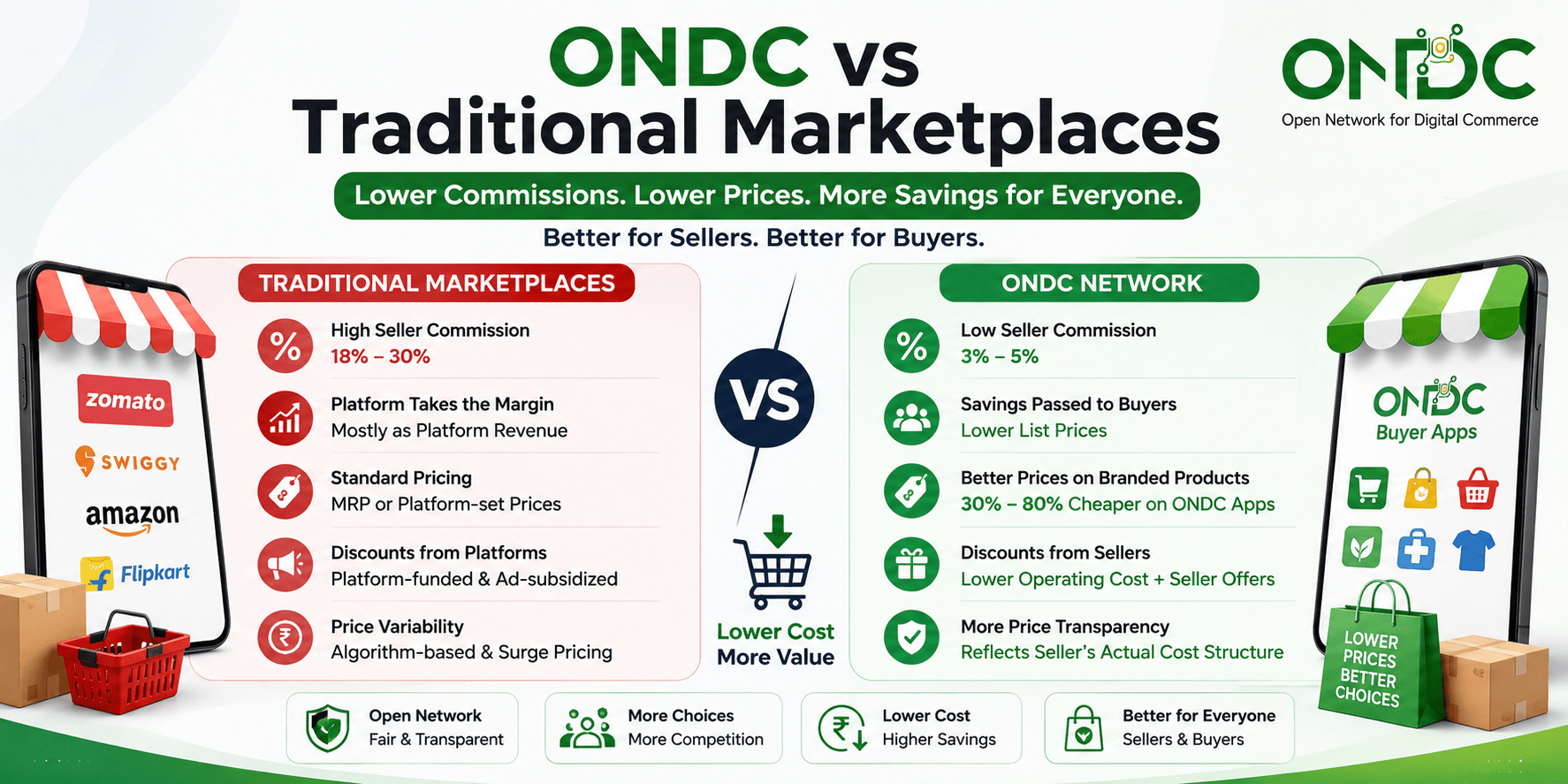
This is where ONDC most consistently wins. Because sellers pay significantly lower commissions on ONDC than on Amazon, flipchart, prices are frequently lower forthe same or comparable products,especially in categories like food delivery, grocery, and smaller D2C brandswhere marketplace commissions historically ran highest.
3. Catalog Depth and Discovery
Amazon and Flipkart have spent years buildingrecommendation engines, massive catalogs, and search algorithms tuned topurchase behavior. ONDC's catalog is broader in a different sense — it includesfar more small, local, and regional sellers who couldn't previously affordmarketplace fees — but discovery and personalization inside any single ONDC buyer is generally less mature than what Amazon or Flipkart have built overa decade.
4. Checkout and Order Experience Consistency
A purchase on Amazon or Flipkart feels the sameevery time, because one company controls every step. On ONDC, a purchasetouches a buyer app, an independent seller, and a logistics provider — threeseparate systems working together through a shared protocol. It generally workssmoothly, but the experience can vary slightly seller to seller, which is thetradeoff for a more open, decentralized network.
5. Delivery Speed and Logistics
Amazon and Flipkart operate their own vast,company-owned logistics networks refined over more than a decade, which is areal advantage for delivery predictability, especially outside metro cities.ONDC relies on a mix of independent logistics providers connected through thenetwork — which increasingly includes strong hyperlocal and quick commerceoptions, but logistics depth still varies more by seller and city than it doeson the established marketplaces.
6. Returns, Refunds, and Disputes
On Amazon or Flipkart, disputes go through onecompany's customer service. On ONDC, returns and cancellations flowthrough the buyer app, the seller, and sometimes a separate logistics provider, each responsible for their part of the process— with ONDC's own neutral grievance layer as a backstop if the buyer app orseller doesn't resolve things in time.
7. Where Each Model Currently Wins
• Amazon tends towin on: premium/branded categories, metro-city delivery speed, catalog breadthin electronics and lifestyle products, and overall app polish
• Flipkart tends towin on: Tier 2/3 city reach, mobile phones and electronics, and India-focused,price-sensitive categories
• ONDC buyer apps tend to win on: lower prices due to reduced seller commissions, access to smalland local sellers, food delivery pricing, and supporting an open rather thansingle-company-controlled market
None of this makes one model universally"better" — it depends on what you're buying and what you'reoptimizing for. A predictable next-day delivery of a premium electronics itemstill often favors Amazon; a cheaper meal from a known restaurant chain or alocal grocery order often favors an ONDC buyer app.
Frequently Asked Questions
Is an ONDC buyer app a single company likeAmazon?
No — ONDC is a protocol connecting 30+independent buyer apps to a shared network of sellers and logistics providers,rather than one company running the entire experience end to end.
Why do sellers on ONDC sometimes feel lessfamiliar than on Amazon or Flipkart?
ONDC's lower barrier to entry means many moresmall, local, and regional sellers can list products without needing the scaleor budget that Amazon and Flipkart's onboarding and advertising requirementsdemand.
Is delivery slower on ONDC compared to Amazon or Flipkart?
It varies by seller and city — Amazon and Flipkart's company-owned logistics networks are more mature overall, but many ONDC-enabled sellers now offer competitive same-day or quick commerce delivery, particularly in metro areas.
Can I trust an unfamiliar seller on an ONDC Buyer Apps the same way I trust Amazon?
ONDC sellers go through onboarding andcertification requirements under the network's policy, and disputes have astructured, time-bound resolution path — but as with any marketplace, it'sstill worth checking a seller's disclosed terms before buying.
Will ONDC eventually replace Amazon ,Flipkart?
That's not the stated goal — ONDC aims to reachroughly 25% of India's e-commerce transactions by 2030, positioning itself as alower-cost, open alternative alongside Amazon and Flipkart rather than a fullreplacement.
Which Should You Use?
Realistically, most shoppers end up using both —Amazon or Flipkart for predictable, branded purchases, and an ONDC buyer app when price matters most or you want to support a local seller directly.Comparing both before a purchase, especially for food delivery, grocery, or D2Cbrands, is often worth the extra minute.
About Costbo
Founded by Mr. Eswar and Mr. Ananth, with nearly 20 years of technology experience, Costbo is a leading ONDC seller platform powering India’s open digital commerce ecosystem. Costbo is among the first ONDC 1.2.0 certified seller platforms, enabling brands and sellers to sell on ONDC with fast onboarding, lower costs, and full operational control.
Ready to grow on ONDC? Start your journey with Costbo today.
Related Reading
• 10 Reasons Why Shopping on ONDC buyer app Is Cheaper Than Amazon, Flipkart & Blinkit
• How Returns, Refunds &Cancellations Work on ONDC Buyer Apps
References
• Top ONDC Buyer And Seller Apps in India [2026] — Shiprocket
• ONDC Integration Guide for Indian E-commerce (2026) — Codingclave
• ONDC 2026: 350 Million Transactions, the "UPI of E-Commerce" — BharatBusinessIndex
• Amazon vs Flipkart vs ONDC: Which Platform Should You Sell On First — Unisouk
Related post
ONDC Discounts & Offers: How Buyers Save More Than on Traditional Marketplaces
.png)
Top ONDC Network Buyer Apps to Use in 2026

Is ONDC Buyer App Safe? Trust, Security & Grievance Redressal for Buyers
Sounds like COSTBO might be the right choice for your business?
Get started by registering your business today! If you have any questions, we're here to help. Our team will reach out to you with detailed information about our offerings, product features, and a demo