

How ONDC Seller Apps Handle Returns, Logistics & Grievances: A Deep Dive into IGM and RSF
Learn how ONDC Seller Apps manage returns, logistics, and customer grievances through the Integrated Grievance Management (IGM) framework and Reconciliation & Settlement Framework (RSF).

India's Open Network for Digital Commerce (ONDC) gets talked about mostly for its promise — democratising e-commerce, breaking Amazon and Flipkart's dominance, and bringing lakhs of kirana stores online. But behind every product listing and every order placed across Paytm, PhonePe Pincode, Meesho, or Magicpin lies an infrastructure that very few sellers truly understand: how returns are processed, how logistics are managed, how grievances are resolved, and how money actually reaches a seller's bank account.
This blog breaks down exactly that — the operational machinery powering ONDC seller apps, with a specific focus on two frameworks that form its backbone: the Issue & Grievance Management (IGM) system and the Reconciliation & Settlement Framework (RSF).
Section 1: The Scale That Makes All This Matter
Before getting into the mechanics, it is worth understanding the scale at which these systems operate.
At this scale, even a 1% grievance rate translates into tens of thousands of unresolved disputes per month — which is precisely why ONDC designed its IGM and RSF frameworks before scaling the network commercially.
Section 2: The Unique Challenge ONDC Faces with Returns & Grievances
On a traditional marketplace like Amazon, one company controls the buyer experience, seller dashboard, logistics, and payments. When something goes wrong, accountability is clear.
ONDC is fundamentally different. A single transaction on ONDC involves at least three distinct, independent entities:
- Buyer App (BAP) — e.g., Paytm, Pincode, Magicpin
- Seller App (BSP/BPP) — e.g., Fynd, GoFrugal, Vikra, MyStore
- Logistics Service Provider (LSP) — e.g., Delhivery, Shadowfax, BlueDart, Ecom Express
When a buyer receives a damaged product, who is responsible — the seller app that listed it, the logistics provider that delivered it, or the buyer app through which the complaint was raised?
This "unbundled architecture" is ONDC's greatest strength (it enables open competition) but also its hardest operational challenge. The IGM framework was specifically designed to solve this problem.
Section 3: How Returns Work on ONDC Seller Apps
Returns on ONDC are not handled centrally. Each seller app has its own returns workflow, but all must comply with ONDC's network-level policies.
3.1 The General Return Flow
Buyer raises return → Buyer App captures the request →
Seller App notified → Seller evaluates eligibility →
Logistics assigned for reverse pick-up →
Item inspected → Refund or replacement initiated →
RSF processes the financial settlement
3.2 Return Policy Variations Across Seller Apps
Different seller apps enforce different return windows and policies. Here is a comparison:
Key Insight for Sellers: Under ONDC, if a return or RTO (Return to Origin) occurs, the seller bears the logistics cost. This is a critical difference from platforms like Flipkart or Meesho where return shipping may be subsidised.
3.3 Refund Timelines
Based on network-level expectations and user reports from 2025, refunds on ONDC typically take 2–3 business days for prepaid orders, routed back through the payment gateway (e.g., Razorpay for many seller apps). COD orders require manual reconciliation, which may take longer.
Section 4: Logistics on ONDC — How It Actually Works
Logistics on ONDC is not centralised. It is a marketplace within a marketplace.
4.1 How Logistics Gets Assigned
When a buyer places an order:
- The ONDC Seller App (or sometimes the buyer) can choose a Logistics Service Provider (LSP) from the ONDC network.
- The LSP is selected based on PIN code coverage, cost, and delivery speed.
- A Transaction-Level Contract (TLC) is created digitally — documenting the rights, obligations, settlement terms, and commissions for all parties in that specific order.
- Once the order is delivered, the settlement process is triggered.
4.2 Major Logistics Partners on ONDC
4.3 The Delivery Consistency Challenge
As of 2025, delivery in metro areas has reached near-parity with traditional e-commerce at 24–48 hours, while Tier 2/3 cities can see delays of 1–3 days longer than platforms like Amazon or Flipkart. Real-time tracking is improving but still inconsistent across some LSPs — a known gap ONDC is actively working to close.
Section 5: The IGM Framework — ONDC's Grievance Architecture
5.1 What Is IGM?
The Issue & Grievance Management (IGM) framework is ONDC's structured, network-wide mechanism for resolving disputes and complaints. It went live officially on September 1, 2023, integrating an Online Dispute Resolution (ODR) mechanism directly into the network.
The framework covers three categories of issues:
- Issues between buyers or sellers and their Network Participants
- Disputes between two Network Participants (e.g., buyer app vs. seller app)
- Issues between a Network Participant and ONDC itself
5.2 The Three-Level Escalation Structure
IGM operates on a strictly time-bound, three-tier escalation model:
🔵 Level 1 — Interfacing App Resolution (Automated)
The complaint is raised through the buyer's or seller's interfacing app. The Grievance Redressal Officer (GRO) of that app evaluates whether the issue falls within their liability.
- If liable → the app resolves it directly.
- If not liable → the issue escalates to Level 2.
Every Network Participant (NP) must have a designated GRO, as mandated by the Consumer Protection (E-Commerce) Rules, 2020. ONDC maintains a registry of all GROs.
🟡 Level 2 — Inter-NP GRO Resolution
When the interfacing app cannot resolve the issue, GROs from the respective Network Participants (buyer app, seller app, and LSP) collaborate to determine liability and reach a resolution. ONDC's leadership may be consulted for guidance.
This level involves structured data points:
- Data Points 1–6: System-generated (order ID, timestamps, transaction details)
- Data Points 7–8: Provided by the complainant (nature of issue, evidence)
- Data Points 13–23: Progressively filled by GROs of respective NPs
🔴 Level 3 — Online Dispute Resolution (ODR)
If Levels 1 and 2 fail to resolve the grievance, the issue moves to an ODR Service Provider. Three mechanisms are available:
At Level 3, evidence is transferred directly from the Network Participants to the ODR Service Provider — the goal is eventually fully automated, without manual intervention.
Unresolved after ODR? The only remaining path is litigation — but ONDC's framework is designed specifically to prevent cases from reaching this stage.
5.3 IGM in Practice — What Sellers Need to Know
5.4 Why IGM Matters for Seller Credibility
A seller's complaint resolution record on ONDC directly influences their discoverability and trust score. Poor grievance performance can result in:
- Reduced catalogue visibility
- Flags from the network's compliance monitoring
- Exclusion from promotions run by buyer apps
Section 6: The RSF — How Money Flows on ONDC
6.1 The Problem RSF Solves
Before RSF, buyer apps were manually settling payments to seller apps via bank portals. This required beneficiary addition, manual entries, and had no regulated oversight — leading to delays, errors, and disputes that eroded seller trust.
The Reconciliation & Settlement Framework (RSF) — now in its version 2.0 — was built to automate and secure this entire flow.
RSF 2.0 was developed by Protean eGov Technologies in collaboration with NPCI Bharat BillPay Limited (NBBL), launched in June 2023. It is now mandatory for all Network Participants under Clause 1.2.2 of the ONDC Network Policy.
6.2 The Actors in RSF
6.3 A Real-Money Example of How RSF Works
Let's say Buyer App X and Seller App Y complete two transactions of ₹2,000 each, with a commission of ₹500.
Step-by-step settlement:
- Buyer App X (Collector) collects ₹4,000 total from buyers.
- The RSP creates a pairwise settlement report.
- The Settlement Agency (NBBL) matches order details from both Seller App Y and Buyer App X.
- NBBL verifies Buyer App X has sufficient funds in its ONDC settlement account.
- Instructions go to the bank: Debit Buyer App X's ONDC account → Credit Seller App Y's ONDC account.
- If Seller App Y has opted for direct payouts to Sellers on Record, NBBL also instructs the bank to transfer the due amount directly to the seller's bank account.
- Any commission is credited to Seller App Y's operational account.
6.4 Benefits of RSF 2.0 for Sellers
6.5 NOCS — The Platform Powering RSF
The underlying technology platform for RSF is NOCS (NBBL Online Commerce Services), which:
- Onboards all ONDC Network Participants and settlement banks
- Provides APIs for reconciliation
- Validates bank accounts of NPs on behalf of ONDC
- Operates under RBI regulatory guidance
Section 7: How RSF and IGM Work Together
RSF and IGM are not independent — they are complementary frameworks that together form ONDC's trust infrastructure.
ORDER PLACED
↓
Transaction-Level Contract created
↓
ORDER DELIVERED
↓
RSF initiates settlement process
↓
[If dispute arises] ──────────────→ IGM Level 1 triggered
↓
Resolved? → RSF adjusts settlement
↓ (if not)
IGM Level 2 (GRO resolution)
↓ (if not)
IGM Level 3 (ODR)
↓
Binding resolution → RSF executes corrected settlement
In practice, this means:
- A refund approved through IGM is executed financially through RSF.
- A disputed commission between two NPs is resolved through IGM and then corrected via RSF.
- The audit trail maintained by Razorpay and NBBL provides the evidence base for IGM proceedings.
Section 8: Key Challenges That Still Exist
Despite the robustness of these frameworks, real-world implementation still has friction points:
1. Return Policy Inconsistency: Not all seller apps enforce uniform return policies. Some smaller vendors lack clear return or warranty commitments, eroding buyer trust.
2. Tracking Gaps: Real-time parcel tracking is still inconsistent across LSPs. Buyers sometimes see "in transit" status even after delivery.
3. Decentralised Customer Service: Customer service on ONDC is forwarded to the seller — there is no centralised helpdesk like Amazon's customer care. This creates variable service quality.
4. Tier 2/3 Delivery Lag: Delivery in less dense geographies remains 1–3 days slower than traditional e-commerce, partly due to logistics partner coverage gaps.
5. IGM Automation Pending: As of now, Level 3 ODR still involves some manual process. Fully automated ODR integration is in progress.
Section 9: What This Means for Sellers — A Practical Checklist
If you are a seller on ONDC or considering joining, here is what you must ensure:
✅ Understand your return policy obligations — Set clear return windows in your seller app dashboard; you bear reverse logistics costs for returns and RTOs.
✅ Know your GRO — Your seller app has a Grievance Redressal Officer. Know who they are and what escalation channels exist.
✅ Register with RSF 2.0 — Ensure your seller app is compliant with RSF 2.0 and integrated with NBBL's NOCS platform for timely payouts.
✅ Choose your LSP wisely — Pick a logistics provider with strong PIN code coverage in your primary markets; delivery failures directly impact your IGM score.
✅ Document everything — The IGM process is evidence-driven. Maintain records of dispatch, packaging, and communication for every order.
✅ Monitor your settlement cycle — With RSF 2.0, understand your settlement timelines with your seller app to manage working capital effectively.
Conclusion: Infrastructure That Earns Trust
ONDC's vision of democratising e-commerce will ultimately be measured not just by how many sellers it onboards, but by how reliably it handles the messiest part of commerce — things going wrong.
The IGM framework, with its time-bound three-level escalation and ODR integration, gives buyers and sellers a structured path to resolution without courts or platform arbitrariness. The RSF 2.0, backed by NPCI Bharat BillPay and operating under RBI guidance, provides the financial integrity that makes sellers trust the network with their revenue.
Together, they represent something rare in Indian e-commerce: a publicly designed, protocol-governed operating layer that is open, auditable, and not owned by any single commercial player. For sellers, understanding these frameworks is not just academic — it is the difference between a smooth operation and a cash-flow nightmare.
Read More
- Building Blocks of ONDC: A Detailed Guide to India’s Open Digital Commerce Infrastructure
- ONDC A Revolutionary Open eCommerce Network – in Action
- Roles of Seller App & Buyer App on ONDC Network
- Why Sell Online Through the ONDC Network?
- Getting Started as a Seller on ONDC: Registration Options
- Which Is the Best ONDC Seller App? Features, Pros & Cons (2026)
- Best ONDC Buyer Apps in 2026: Features, Pros & Cons
- What is ONDC Buyer App
Related post
.png)
ONDC Buyer App vs Amazon/Flipkart App: What's Actually Different for Shoppers
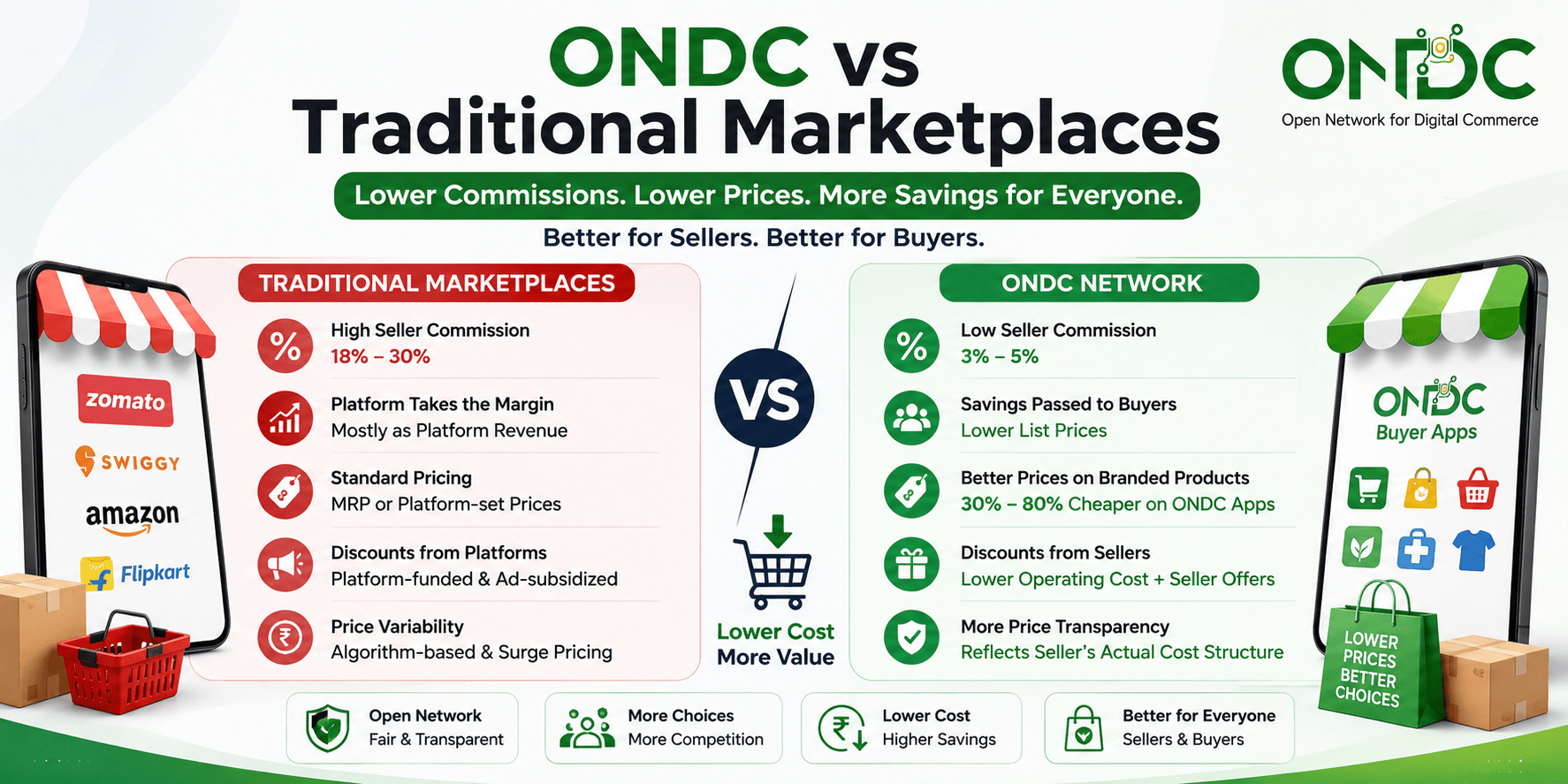
ONDC Discounts & Offers: How Buyers Save More Than on Traditional Marketplaces
.png)
Top ONDC Network Buyer Apps to Use in 2026

Sounds like COSTBO might be the right choice for your business?
Get started by registering your business today! If you have any questions, we're here to help. Our team will reach out to you with detailed information about our offerings, product features, and a demo