

How to Set Up an Online Store on the ONDC Platform
Step-by-step guide to start selling on ONDC in India. Learn how to onboard, upload your catalog, manage payments and logistics with seller platforms.

India’s e-commerce sector is growing rapidly and is expected to reach $200 billion by 2026 and over $350 billion by 2030 according to multiple industry reports. Despite this growth, only around 10–12% of India’s total retail sales happen online, which means a large portion of retail is still moving toward digital platforms.
To enable wider participation in digital commerce, the Government of India launched the Open Network for Digital Commerce (ONDC). The initiative aims to create an open, interoperable network where sellers can list products and reach customers across multiple apps instead of relying on a single marketplace.
Some important data points about ONDC:
- ONDC is now active in 1200+ cities across India.
- The network supports thousands of sellers and merchants across categories.
- Multiple buyer apps such as Paytm, Mystore, and DigiHaat allow customers to discover ONDC sellers.
- ONDC enables interoperability between seller platforms, logistics providers, and payment systems.
This ecosystem allows businesses—from local retailers to D2C brands—to set up an online store and reach customers across different buyer applications.
Step-by-Step Guide to Set Up an Online Store on ONDC
1. Choose an ONDC Seller Platform
The first step to selling on ONDC is selecting an ONDC seller platform. These platforms act as technology providers that connect your business to the ONDC network.
Seller platforms provide tools for:
- Store onboarding
- Product catalog management
- Order processing
- Payment settlements
- Logistics integration
Examples of seller platforms include Costbo, DigiHaat, and Shopclues.
These platforms simplify the onboarding process and help sellers comply with ONDC network protocols and standards.
2. Complete Seller Registration and Business Verification
After choosing a seller platform, businesses must complete the registration process.
Typical requirements include:
- Business name and address
- GST registration (for most categories)
- PAN details
- Bank account information
- Identity verification
The seller platform usually guides merchants through the ONDC onboarding process and ensures that the business profile complies with network requirements.
3. Upload or Sync Your Product Catalog
One major advantage of ONDC is that sellers do not always need to create a catalog from scratch.
If you are already selling on marketplaces like Amazon or Flipkart, the same product catalog can often be imported or synchronized to the ONDC platform through supported seller platforms, this also depends on seller platform
This makes onboarding much faster because sellers can reuse:
- Product titles
- Descriptions
- Images
- Pricing
- Inventory data
Proper catalog formatting is important because ONDC follows standardized product listing structures.
4. Configure Payments and Settlements
Payments on ONDC are handled through integrated payment systems.
Customers can pay using:
- UPI
- Credit and debit cards
- Net banking
- Wallet payments
Settlement cycles depend on the seller platform but typically range between T+2 to T+7 days. The seller platform manages the payment flow and ensures the funds are credited to the seller’s bank account after order completion.
5. Set Up Logistics and Delivery
Delivery on ONDC is enabled through logistics partners integrated into the network.
Sellers can choose between:
Self-delivery
Where the merchant handles packaging and shipping.
Network logistics partners
Where third-party logistics providers handle pickup and delivery.
This flexibility helps sellers manage both hyperlocal delivery and nationwide shipping.
6. Ensure Compliance With ONDC Network Standards
All sellers must follow ONDC protocol standards to ensure interoperability across the network.
These standards cover areas such as:
- Product data format
- Order processing workflows
- Return and cancellation policies
- Inventory updates
Seller platforms usually handle most of the technical compliance requirements so that merchants can focus on selling.
7. Launch Your Store and Start Receiving Orders
Once the catalog, payments, and logistics are configured, the store becomes active on the ONDC network.
Your products can then appear across multiple ONDC buyer apps, allowing customers to discover and purchase them.
After launch, sellers can manage:
- Order processing
- Inventory updates
- Customer support
- Performance analytics
This allows businesses to operate a multi-platform digital store through a single integration.
How Seller Platforms Simplify ONDC Selling
For most businesses, managing the technical aspects of ONDC integration can be complex. Seller platforms simplify the process by offering:
- Easy onboarding dashboards
- Automated catalog uploads
- Order management systems
- Integrated logistics and payment solutions
- Compliance with ONDC standards
This enables even small businesses and local retailers to participate in digital commerce without building their own technology infrastructure.
How Costbo Helps Businesses Sell on ONDC
Before starting their ONDC journey, businesses often need a reliable seller platform that simplifies onboarding and daily operations.
Costbo is an ONDC seller platform designed to help merchants quickly set up their online store and start selling across the ONDC network.
With Costbo, sellers can:
- Easily onboard to ONDC
- Upload or sync product catalogs
- Manage single and multiware house on mobile apps
- Access logistics and payment integrations
- Reach customers across multiple ONDC buyer apps
- Cheapest and best logistics charges
- Easy marketing and customer engagement
This makes it easier for businesses to expand their online presence without depending on a single marketplace.
Conclusion
The ONDC platform is transforming India’s digital commerce ecosystem by creating an open network where sellers can reach customers across multiple apps.
Setting up an online store on ONDC involves selecting a seller platform, registering the business, uploading a product catalog, configuring payments and logistics, and ensuring compliance with network standards.
With the help of seller platforms and interoperable infrastructure, businesses—from small retailers to established brands—can now participate in India’s growing digital commerce market more easily than ever before.
Frequently Asked Questions (FAQ)
1. What is ONDC in simple terms?
ONDC is an open digital commerce network that allows buyers and sellers to interact across different apps instead of relying on a single marketplace.
2. Do sellers need a website to sell on ONDC?
No. Sellers can use an ONDC seller platform to list products and manage orders without having their own website.
3. Can existing Amazon or Flipkart catalogs be used on ONDC?
Yes. Many seller platforms allow merchants to import or reuse their existing product catalog from marketplaces like Amazon or Flipkart.
4. Who manages payments on ONDC?
Payments are handled through integrated payment gateways, and settlements are processed through the seller platform.
5. Who handles delivery for ONDC orders?
Delivery can be handled by logistics partners integrated into the ONDC network or by the seller through self-delivery.
6. Is ONDC only for large businesses?
No. ONDC is designed to help small retailers, local shops, and D2C brands participate in digital commerce.
7. How long does it take to start selling on ONDC?
Depending on the seller platform and catalog readiness, businesses can typically start selling within a few days to a couple of weeks.
References
- ONDC Official Website – https://ondc.org
- DPIIT (Department for Promotion of Industry and Internal Trade)
- RedSeer Consulting – India E-commerce Market Insights
- Government of India ONDC Network Documentation
Related post
.png)
.png)
How Multiple Buyer Apps Access the Same Sellers on ONDC (Network Effect Explained Simply)
.png)
ONDC Buyer App vs Amazon/Flipkart App: What's Actually Different for Shoppers
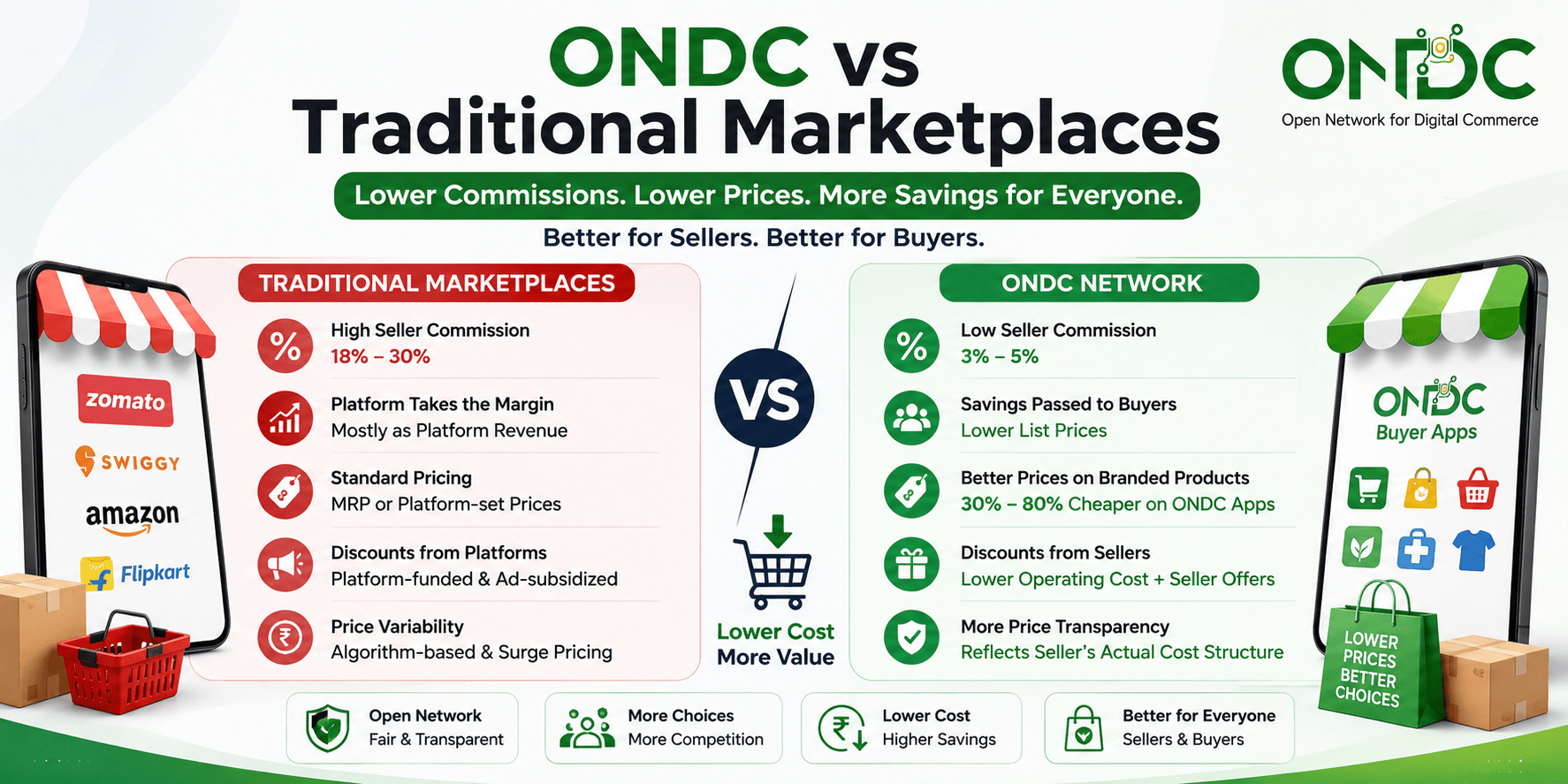
ONDC Discounts & Offers: How Buyers Save More Than on Traditional Marketplaces
Sounds like COSTBO might be the right choice for your business?
Get started by registering your business today! If you have any questions, we're here to help. Our team will reach out to you with detailed information about our offerings, product features, and a demo