

Best ONDC Buyer Apps in 2026: Features, Pros & Cons
We covers only the active and relevant ONDC Buyer Apps in 2026, with a clear comparison of their strengths and limitations.

India’s e-commerce landscape is undergoing a structural transformation. Traditional marketplace-led commerce—dominated by a few closed platforms—is gradually giving way to open, interoperable digital networks where buyers can discover products across multiple sellers without being locked into a single marketplace.
At the center of this shift is the Open Network for Digital Commerce (ONDC), a Government of India–backed initiative launched in 2023 to democratize digital commerce. ONDC separates the ecosystem into buyer apps, seller apps, and logistics/payment providers, enabling true platform neutrality—much like how UPI transformed digital payments.
ONDC Scale & Growth: Key Data Points (2024–2026)
According to ONDC disclosures and industry estimates, the buyer-side ecosystem has scaled rapidly:
- 350+ million cumulative transactions processed as of late 2025
- March 2025 alone: ~1.6 crore orders, contributing to 20.4 crore cumulative transactions
- Daily transaction run-rate (early 2025): 5–6 lakh orders per day
- Target by end of 2026: 50–60 lakh daily transactions (≈10× growth)
- Seller ecosystem powering buyer apps:
- 7.6 lakh+ sellers and service providers onboarded
- 1.16 lakh+ active retail sellers across 630+ cities
- Category growth impacting buyer experience:
- Mobility ~40% of transactions, 120% growth in 8 months
- Non-mobility categories grew 825%, with food delivery up 300%
- Enterprise availability on buyer apps:
- 8 lakh+ service providers, including Domino’s, Unilever, Haldiram’s, Wow! Momo
- Geographic reach:
- Buyer apps live in 800+ cities and towns, with strong Tier-2, Tier-3 & Bharat adoption
Why ONDC Buyer Apps Matter
ONDC Buyer Apps are the consumer-facing layer of the network. They are responsible for:
- Product discovery & search
- Price comparison across sellers
- Checkout & payments
- Order tracking & grievance flows
Unlike traditional marketplaces, buyer apps do not own inventory. Their success depends on:
- Seller app reliability
- Logistics performance
- UX and category focus
A Reality Check on ONDC Buyer Apps
Although nearly 100 buyer apps have been registered on ONDC historically (as per ONDC.org):
- Many early apps have paused consumer operations
- Several failed to keep up with protocol upgrades
- Some remained pilot-only or inactive
- Only a small subset are production-ready and driving real volumes
👉 This blog covers only the active and relevant ONDC Buyer Apps in 2026, with a clear comparison of their strengths and limitations.
🇮🇳 Top ONDC Buyer Apps in India (2026)
1. DigiHaat
Bharat-Focused ONDC Buyer App
DigiHaat is one of the most visible Bharat-focused ONDC buyer apps, designed to promote local sellers, artisans, and MSMEs.
Pros:
✅ Strong adoption in Tier-2 & Tier-3 cities
✅ Focus on local & regional sellers
✅ Government-aligned Bharat commerce vision
Cons:
⚠️ Limited premium brand presence
⚠️ UX still evolving compared to private marketplaces
2. HamaraMal
HamaraMal focuses on hyperlocal and neighbourhood commerce, connecting nearby sellers with local buyers.
Pros:
✅ Good for local discovery
✅ Supports neighbourhood merchants
Cons:
⚠️ Limited scale beyond select regions
⚠️ Lower order volumes than top buyer apps
3. Bajaj Markets
Bajaj Markets integrates ONDC into its fintech-led marketplace, enabling product discovery with financing and EMI options.
Pros:
✅ Strong brand trust
✅ Financing & EMI integration
✅ Good for electronics & appliances
Cons:
⚠️ Category-limited focus
⚠️ Less hyperlocal depth
4. Airpay
Airpay participates in ONDC primarily through payments and assisted commerce buyer flows, often embedded within enterprise or assisted journeys.
Pros:
✅ Strong payments backbone
✅ Useful in assisted buying scenarios
Cons:
⚠️ Not a consumer-first shopping app
⚠️ Limited discovery experience
5. Easy Pay
Easy Pay operates in assisted digital commerce, enabling ONDC purchases via semi-assisted buyer journeys.
Pros:
✅ Suitable for offline-to-online buyers
✅ Strong payment and settlement flows
Cons:
⚠️ Limited consumer UX
⚠️ Not designed for mass e-commerce discovery
6. Magicpin
Most Active ONDC Buyer App
Magicpin is one of the largest transaction-driving ONDC buyer apps, especially strong in food delivery and hyperlocal retail.
Pros:
✅ High daily order volumes
✅ Strong restaurant & local merchant network
✅ Fast-growing ONDC adoption
Cons:
⚠️ Heavily skewed towards F&B
⚠️ Limited non-hyperlocal depth
7. Mystore
Mystore operates as a general-purpose ONDC buyer app, aggregating products across categories.
Pros:
✅ Wide product availability
✅ Simple buying experience
Cons:
⚠️ Limited brand recall
⚠️ Moderate UX and engagement
8. Novopay
Novopay enables ONDC purchases through assisted commerce and fintech-led buyer journeys.
Pros:
✅ Strong presence in assisted retail
✅ Good for financial inclusion use cases
Cons:
⚠️ Not consumer-shopping focused
⚠️ Limited discovery UX
9. NStore
NStore focuses on store-led discovery, allowing buyers to shop directly from nearby physical stores.
Pros:
✅ Strong local retail connect
✅ Offline-to-online experience
Cons:
⚠️ Limited national scale
⚠️ Smaller seller base
10. Vi Store
Vi Store integrates ONDC into telecom-led retail, enabling device and accessory discovery.
Pros:
✅ Trusted telecom brand
✅ Strong offline presence
Cons:
⚠️ Very limited category scope
⚠️ Not a general commerce app
🧩 ONDC Buyer App Comparison (2026)
Final Verdict
ONDC Buyer Apps are no longer experimental—they are actively shaping how Indians discover and purchase goods across categories.
However, buyer apps differ significantly in:
- Scale
- Category depth
- UX maturity
- Transaction reliability
In 2026:
- Magicpin leads in transaction volume and hyperlocal commerce
- DigiHaat excels in Bharat-focused discovery
- Bajaj Markets stands out for financed purchases
👉 The best ONDC buyer app depends on what you want to buy, but Magicpin currently leads in overall ONDC buyer adoption and activity.
Frequently Asked Questions (FAQs)
1. What is an ONDC Buyer App?
An ONDC Buyer App is a consumer-facing application that allows users to search, discover, and purchase products from multiple sellers on the ONDC network.
2. Which are the most popular ONDC buyer apps in India in 2026?
In 2026, the most active and production-ready ONDC buyer apps include Magicpin, DigiHaat, Bajaj Markets, Mystore, and NStore. Among these, Magicpin leads in transaction volume, especially in food delivery and hyperlocal retail.
3. Are ONDC buyer apps safe to use?
Yes. ONDC buyer apps follow network-level protocols for payments, order tracking, and grievance redressal.
4. Can I use multiple ONDC buyer apps?
Yes. Buyers can use multiple apps to compare prices, availability, and delivery options.
5. Is ONDC only for small sellers?
No. ONDC buyer apps list products from both local MSMEs and large brands.
6. Are ONDC buyer apps owned by the government?
No. ONDC buyer apps are privately built and operated. ONDC itself is a government-backed network and protocol layer, but buyer apps like Magicpin, Bajaj Markets, and Mystore are independent companies participating in the open network.
7. Do ONDC buyer apps sell only local or small-brand products?
No. While local MSMEs form a large part of ONDC, buyer apps also list products from large enterprises and national brands such as Domino’s, Unilever, Haldiram’s, and Wow! Momo, depending on category and seller availability.
References
- Open Network for Digital Commerce (ONDC) – Official Website
https://ondc.org - DPIIT – Government of India (ONDC Initiative)
https://dpiit.gov.in
Policy framework and ONDC governance
About Costbo
Founded by Mr. Eswar and Mr. Ananth, with nearly 20 years of technology experience, Costbo is a leading ONDC seller platform powering India’s open digital commerce ecosystem. Costbo is among the first ONDC 1.2.0 certified seller platforms, enabling brands and sellers to sell on ONDC with fast onboarding, lower costs, and full operational control.
Ready to grow on ONDC? Start your journey with Costbo today.
Related post
.png)
ONDC Buyer App vs Amazon/Flipkart App: What's Actually Different for Shoppers
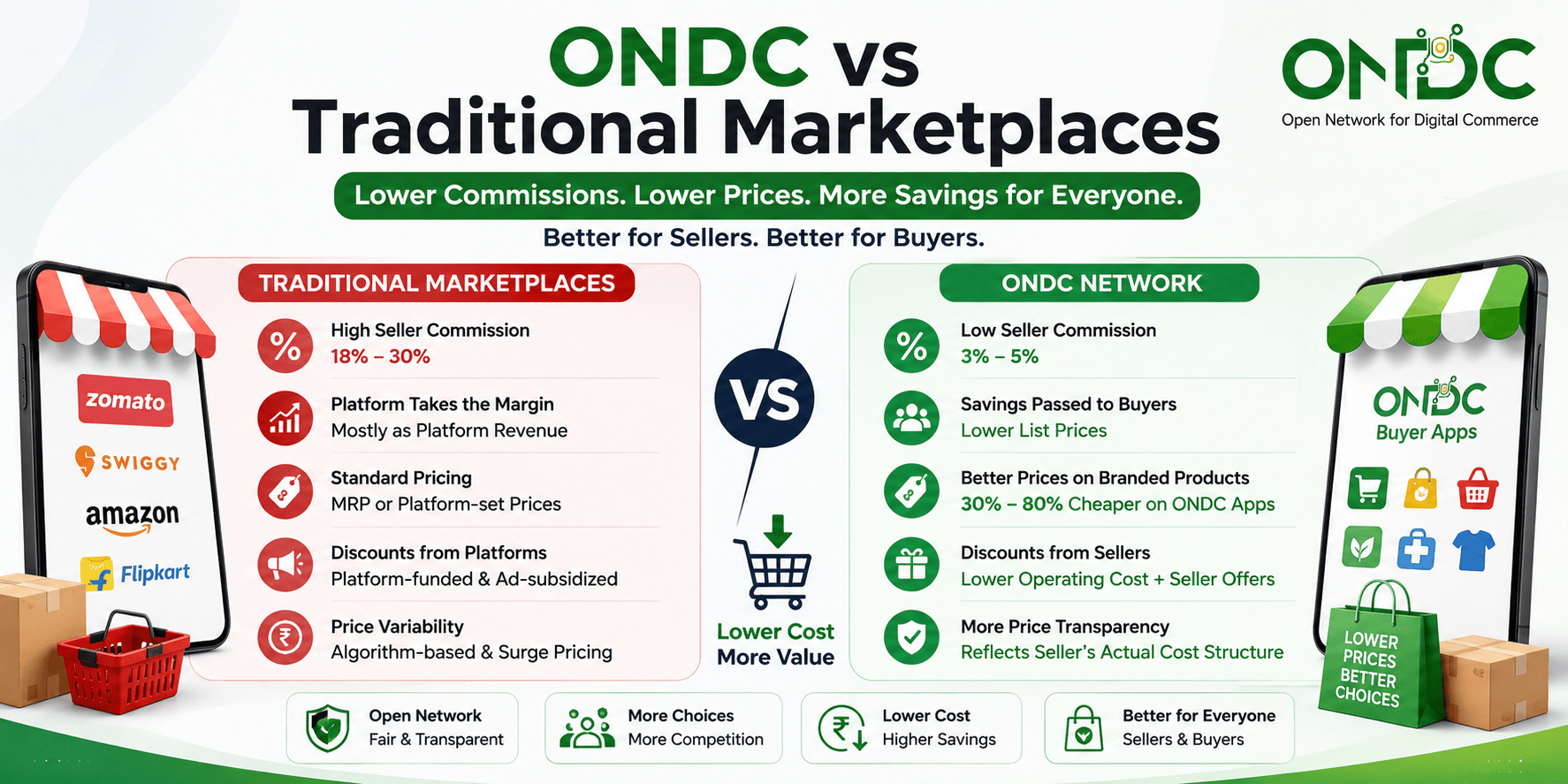
ONDC Discounts & Offers: How Buyers Save More Than on Traditional Marketplaces
.png)
Top ONDC Network Buyer Apps to Use in 2026

Sounds like COSTBO might be the right choice for your business?
Get started by registering your business today! If you have any questions, we're here to help. Our team will reach out to you with detailed information about our offerings, product features, and a demo