

ONDC vs UPI: Are They Really That Similar?
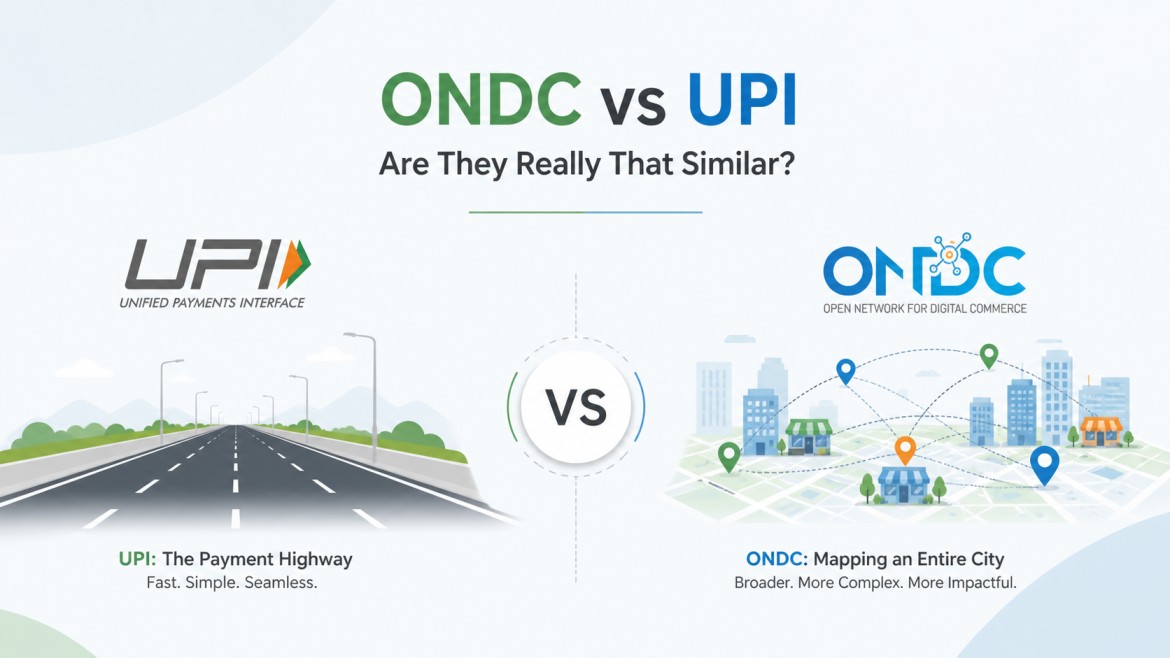
India has already built one of the world’s most successful digital infrastructures with Unified Payments Interface (UPI). Now, another ambitious initiative—Open Network for Digital Commerce (ONDC)—is gaining momentum.
At a glance, both look similar: government-backed, open networks, designed to democratize access. But when you dig deeper, they are solving very different problems.
Let’s start with some real numbers:
- UPI processes 10+ billion transactions every month
- Monthly transaction value crosses ₹200 lakh crore
- Over 350+ banks and apps are integrated with UPI
- ONDC has crossed 10+ million monthly transactions (and growing rapidly)
- ONDC is live across multiple categories—food delivery, grocery, retail, logistics, mobility
- UPI reached massive scale in about 5–7 years
- ONDC is still in its early growth phase (2–3 years in)
So yes, both are powerful. But comparing them directly is like comparing a highway to an entire city.
UPI: The Smooth, High-Speed Payment Highway
UPI is simple—and that’s exactly why it worked.
It was built by National Payments Corporation of India with one clear goal: make sending money instant, easy, and universal.
Think about your daily life. Whether you are paying a chaiwala, splitting a bill, or shopping online—you just scan and pay. Done in seconds.
Why UPI scaled so fast:
- Single use case → only payments
- Instant transactions → real-time money transfer
- Interoperability → any app works with any bank
- Low entry barrier → just a smartphone and bank account
- Strong ecosystem push → apps like PhonePe, Google Pay, Paytm
UPI didn’t try to solve everything. It focused on one problem and solved it extremely well.
👉 That’s why it feels like a well-built express highway—
Clear rules, smooth flow, and high speed.
🌐 ONDC: Building an Entire Commerce City
Now let’s talk about ONDC—and this is where things get interesting.
ONDC is not just about transactions. It is trying to rebuild how digital commerce works in India.
Instead of one platform controlling everything (like Amazon or Swiggy), ONDC creates an open network where:
- Buyers can shop from multiple apps
- Sellers can list products without being locked into one platform
- Logistics providers can plug in independently
- Payments can happen through UPI or other methods
What ONDC is really solving:
- Breaking platform monopolies
- Giving small sellers digital visibility
- Reducing high commissions
- Creating an open, interoperable commerce ecosystem
But here’s the catch—complexity.
Unlike UPI, ONDC has multiple moving parts:
- Buyer apps
- Seller apps
- Catalog systems
- Logistics providers
- Pricing and inventory sync
- Order management
- Customer experience
- Payments
👉 Imagine this as a city:
- Roads = protocols
- Shops = sellers
- Delivery vans = logistics
- Traffic rules = standards
Now compare that to a highway. You immediately see the difference.
⚖️ ONDC vs UPI: The Real Comparison
Let’s simplify it further:
UPI is like sending a message: quick and direct.
ONDC is like running a business: layered and dynamic.
🧠 Why People Compare Them (And Where It Goes Wrong)
You might have heard people say:
👉 “ONDC is the UPI of e-commerce.”
This is partly true—but also misleading.
What’s similar:
- Both are open networks
- Both promote interoperability
- Both are backed by the government
- Both aim to democratize access
What’s different:
- UPI handles money movement
- ONDC handles entire commerce flow
That’s a huge difference.
UPI success came from simplicity.
ONDC success will come from ecosystem coordination.
📈 Can ONDC Become as Big as UPI?
Short answer: Yes—but not in the same way.
UPI scaled because:
- Everyone needs payments
- The use case is universal
- The experience is simple
ONDC has a longer journey because:
- Commerce behavior is complex
- Sellers need onboarding and education
- Logistics needs standardization
- Customer experience varies across apps
Growth drivers for ONDC:
- Government push
- MSME digitization
- Lower commission structure
- Increased competition in e-commerce
Challenges:
- Fragmented UX
- Inconsistent service quality
- Trust building among users
If everything aligns, ONDC could become:
👉 India’s largest open digital commerce ecosystem
But it will take time, patience, and strong execution.
🔗 The Hidden Truth: ONDC and UPI Work Together
Here’s something many people miss:
ONDC doesn’t replace UPI—it actually depends on it.
Most ONDC transactions still use UPI for payments.
So instead of comparing them, think of it like this:
- UPI = Payment layer (foundation)
- ONDC = Commerce layer (application)
Together, they create a powerful digital economy stack.
✅ Conclusion: Where Costbo Fits In
UPI showed India how powerful digital public infrastructure can be.
ONDC is taking that vision forward—into commerce.
But ONDC’s success depends heavily on ease of adoption for sellers.
This is where platforms like Costbo come in.
Costbo is a popular ONDC seller app that simplifies onboarding, catalog management, and order handling for businesses. Instead of struggling with the complexity of ONDC, sellers can use Costbo to:
- Easily list products
- Manage inventory
- Access ONDC buyers
- Scale without high marketplace commissions
👉 In a way, if ONDC is the city…
Costbo helps you open your shop quickly and start selling without confusion.
FAQs
1. Is ONDC the same as UPI?
No. UPI is a payment system, while ONDC is a full commerce network involving buyers, sellers, and logistics.
2. Why did UPI grow faster than ONDC?
Because UPI solves a single, simple problem—payments. ONDC deals with multiple complex layers like logistics, inventory, and customer experience.
3. Can ONDC replace Amazon or Flipkart?
Not exactly. ONDC is not a platform but a network that allows multiple apps and sellers to participate freely.
4. Do ONDC transactions use UPI?
Yes, in many cases UPI is used as the payment method within ONDC transactions.
5. Is ONDC good for small businesses?
Yes. It reduces dependency on big platforms and lowers commission costs, helping small sellers reach more customers.
6. How can a seller start on ONDC?
Sellers can onboard through ONDC-compatible seller apps like Costbo, which simplify the process.
References
- National Payments Corporation of India – UPI data and reports
- Open Network for Digital Commerce – Official ONDC resources
- Ministry of Commerce & Industry, Government of India
- RBI Digital Payments Reports
- Industry insights from BCG and Bain on India’s digital economy
About Costbo
Founded by Mr. Eswar and Mr. Ananth, with nearly 20 years of technology experience, Costbo is a leading ONDC seller platform powering India’s open digital commerce ecosystem. Costbo is among the first ONDC 1.2.0 certified seller platforms, enabling brands and sellers to sell on ONDC with fast onboarding, lower costs, and full operational control.
Ready to grow on ONDC? Start your journey with Costbo today.
Read More
- Building Blocks of ONDC: A Detailed Guide to India’s Open Digital Commerce Infrastructure
- ONDC A Revolutionary Open eCommerce Network – in Action
- Roles of Seller App & Buyer App on ONDC Network
- Why Sell Online Through the ONDC Network?
- Getting Started as a Seller on ONDC: Registration Options
- Which Is the Best ONDC Seller App? Features, Pros & Cons (2026)
- Best ONDC Buyer Apps in 2026: Features, Pros & Cons
- What is ONDC Buyer App
Related post
.png)
.png)
How Multiple Buyer Apps Access the Same Sellers on ONDC (Network Effect Explained Simply)
.png)
ONDC Buyer App vs Amazon/Flipkart App: What's Actually Different for Shoppers
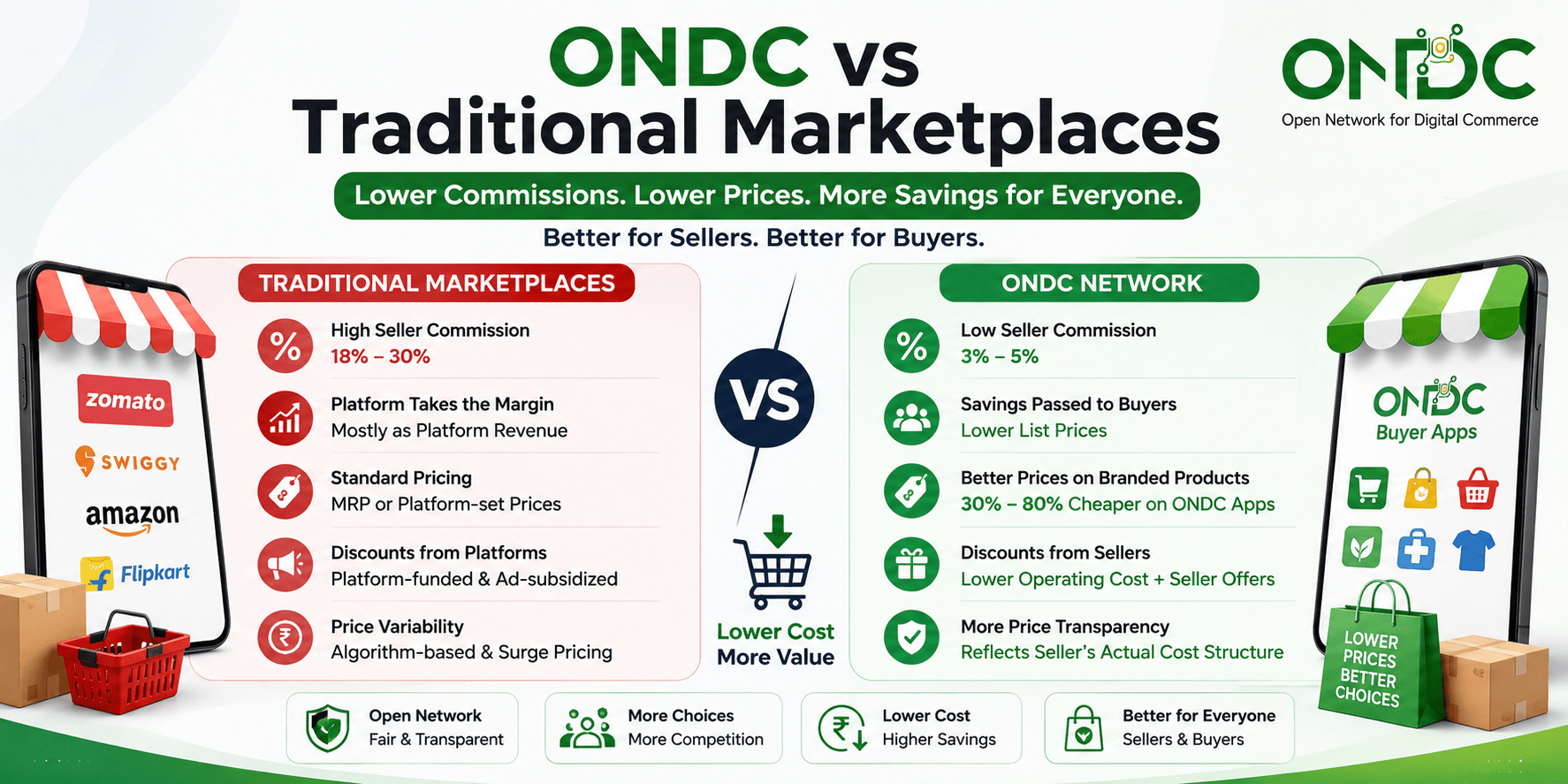
ONDC Discounts & Offers: How Buyers Save More Than on Traditional Marketplaces
Sounds like COSTBO might be the right choice for your business?
Get started by registering your business today! If you have any questions, we're here to help. Our team will reach out to you with detailed information about our offerings, product features, and a demo