

ONDC vs Amazon: Which is Better for Sellers in India (2026 Guide)
ONDC vs Amazon explained with data. Compare commissions, reach, logistics, and seller control to choose the right platform in 2026.

India’s e-commerce market is expected to cross $200 billion by 2026, growing at a CAGR of ~18–20%. For years, platforms like Amazon and Flipkart have dominated this space, controlling demand, discovery, and customer access.
But things are changing.
The Open Network for Digital Commerce (ONDC) — launched by the Government of India — is reshaping how online selling works:
- 350+ million cumulative transactions processed by late 2025
- 5–6 lakh daily orders already being handled
- Target of 50–60 lakh daily orders by 2026
- 7.6 lakh+ sellers and service providers onboarded
- Active presence in 800+ cities, especially Tier-2 and Tier-3 India
At the same time, Amazon India continues to be a giant:
- Over 1 million sellers on the platform
- Access to 100M+ Prime users in India
- Logistics coverage across 100% serviceable pin codes
- Dominant in categories like electronics, fashion, and FMCG
So the big question is:
Should you sell on ONDC or Amazon? Or both?
Let’s break it down in a practical, seller-first way.
ONDC vs Amazon: Core Difference Explained
Before comparing features, it’s important to understand the fundamental difference.
Amazon = Marketplace Model
Amazon is a closed ecosystem:
- You list products on Amazon
- Customers discover you only within Amazon
- Amazon controls visibility, ranking, and customer data
ONDC = Open Network Model
ONDC is not a marketplace:
- You connect via a seller app
- Your products are visible across multiple buyer apps
- No single platform controls demand
👉 Think of it like this:
Amazon = Mall
ONDC = Internet for commerce
1. Reach & Customer Access
Amazon
- Massive built-in customer base
- High traffic and instant visibility
- Strong trust factor (Prime, reviews, delivery)
ONDC
- No single customer pool
- Reach comes from multiple buyer apps (Magicpin, Paytm, etc.)
- Growing rapidly, especially in Bharat markets
👉 Verdict:
Amazon wins in instant reach, but ONDC offers distributed discovery across platforms
2. Control Over Business
Amazon
- Limited control over:
- Pricing wars
- Listing visibility (algorithm-driven)
- Customer relationship
- Risk of:
- Account suspension
- Buy Box dependency
ONDC
- Full control over:
- Pricing
- Inventory
- Customer experience
- No dependency on a single platform
👉 Verdict:
ONDC clearly wins on seller control and independence
3. Commission & Cost Structure
Amazon
Typical costs:
- Referral fees: 5%–25% (category dependent)
- Fulfillment (FBA) fees
- Advertising costs (often mandatory for visibility)
👉 Effective cost can go up to 25–40% of product price
ONDC
- Lower commission structure
- Network fees are significantly lower (often <10%)
- No forced ad spend for visibility
👉 Verdict:
ONDC is more cost-efficient, especially for MSMEs and D2C brands
4. Discovery & Competition
Amazon
- Highly competitive marketplace
- Dominated by:
- Large sellers
- Private labels
- Sponsored listings
👉 Organic visibility is difficult without ads
ONDC
- Still evolving
- Lower competition (as of 2026)
- Fairer discovery due to open network
👉 Verdict:
ONDC offers a level playing field, while Amazon is pay-to-win
5. Logistics & Fulfillment
Amazon
- Best-in-class logistics (FBA)
- Fast delivery (Prime, same-day, next-day)
- Strong reverse logistics
ONDC
- Logistics handled via partners (Shiprocket, etc.)
- Flexibility:
- Seller-managed
- Third-party logistics
- Still improving in consistency
👉 Verdict:
Amazon wins in logistics reliability, ONDC offers flexibility
6. Scalability & Long-Term Growth
Amazon
- Easy to start
- Hard to scale profitably (due to fees + competition)
ONDC
- Slightly complex to start
- Better for long-term scalability
- One integration → multiple buyer apps
👉 Verdict:
ONDC is better for long-term brand building and scale
7. Data Ownership & Branding
Amazon
- Amazon owns customer data
- Limited branding opportunities
ONDC
- Sellers retain more control
- Better scope for:
- Branding
- Customer relationships
👉 Verdict:
ONDC is better for building your own brand
Quick Comparison Table
So, Which Is Better for Sellers?
👉 The real answer is: It depends on your goal
Choose Amazon if:
- You want quick sales
- You’re okay with high competition
- You rely on platform-driven traffic
Choose ONDC if:
- You want long-term growth
- You want control over your business
- You want to reduce dependency on marketplaces
Final Conclusion
ONDC is not here to replace Amazon overnight — but it is changing the rules of the game.
Amazon still dominates in terms of:
- Traffic
- Logistics
- Immediate sales
But ONDC is building something much bigger:
- An open, interoperable commerce ecosystem
- Where sellers are not locked into one platform
- And where costs, control, and scalability improve over time
👉 For smart sellers in 2026, the strategy is not ONDC vs Amazon
👉 It’s ONDC + Amazon
Use Amazon for cash flow, and ONDC for long-term scale and independence
Frequently Asked Questions (FAQs)
1. What is ONDC platform?
ONDC (Open Network for Digital Commerce) is a Government of India–backed initiative that creates an open network for buying and selling online. Unlike Amazon or Flipkart, ONDC is not a marketplace. It connects buyers and sellers through multiple apps, allowing businesses to sell across platforms instead of being restricted to just one.
2. How much does ONDC charge for seller registration?
ONDC itself does not directly charge sellers for registration. However, sellers typically onboard through a seller app (like Costbo, etc.), which may have:
- Setup or onboarding fees
- Subscription charges
- Transaction/network fees
Compared to marketplaces, overall costs on ONDC are generally lower and more transparent.
3. How to join ONDC as a seller?
Joining ONDC is a straightforward process:
- Choose an ONDC Seller App (like Costbo, etc.)
- Complete KYC and business verification
- Set up your store (catalog, pricing, service areas)
- Integrate logistics and payment systems
- Go live and start receiving orders from multiple buyer apps
Most platforms also offer assisted onboarding, so technical expertise is not mandatory.
4. Is ONDC owned by the Government?
ONDC is a Government-backed initiative under the Department for Promotion of Industry and Internal Trade (DPIIT).
However, it operates as a not-for-profit company, with participation from both public and private stakeholders.
5. Who is the CEO of ONDC?
As of recent updates, T. Koshy is the Chief Executive Officer of ONDC. He plays a key role in building and scaling the open commerce network across India.
6. Which is the best ONDC seller platform?
In 2026, Costbo is considered one of the best ONDC seller platforms, especially for serious sellers. Here’s why:
- End-to-end seller management (catalog, orders, payments, logistics)
- Single integration → multiple buyer apps (Magicpin, DigiHaat, etc.)
- Fully compliant with latest ONDC protocols
- Strong analytics and automation tools
- Availabe on mobile apps
- Manage multi warehouse
- Inbuild Marketing features
- Lowest logistics cost
- Suitable for entriprise as well as scaling brands
👉 If you’re looking for long-term growth, control, and scalability, Costbo stands out as a strong choice.
7. Is ONDC better than Amazon for new sellers?
ONDC can be better for long-term growth due to lower costs and less competition. However, Amazon is easier for quick sales because of its large customer base.
8. Can I sell on both ONDC and Amazon?
Yes. Many sellers use Amazon for immediate revenue and ONDC for building a scalable, independent business.
9. Does ONDC charge commission like Amazon?
Yes, but significantly lower. ONDC network fees are generally much lower compared to Amazon’s referral and fulfillment fees.
10. Why are ONDC orders still lower than Amazon?
ONDC is still growing. While it is scaling rapidly, it hasn’t yet reached Amazon’s maturity and user base.
11. Do I need ads to get orders on ONDC?
Not necessarily. ONDC focuses on open discovery, so sellers are not heavily dependent on paid ads like on Amazon.
12. Which platform is better for D2C brands?
ONDC is better for D2C brands because it offers more control over pricing, branding, and customer relationships.
13. Is ONDC suitable for small businesses?
Yes. ONDC is designed to empower MSMEs, local sellers, and small businesses by reducing dependency on large marketplaces.
References
- https://ondc.org
- https://dpiit.gov.in
- Invest India Reports on E-commerce Growth
- RedSeer & Bain India E-commerce Market Reports
- Amazon Seller Central India Documentation
Read More
- Building Blocks of ONDC: A Detailed Guide to India’s Open Digital Commerce Infrastructure
- ONDC A Revolutionary Open eCommerce Network – in Action
- Roles of Seller App & Buyer App on ONDC Network
- Why Sell Online Through the ONDC Network?
- Getting Started as a Seller on ONDC: Registration Options
- Which Is the Best ONDC Seller App? Features, Pros & Cons (2026)
- Best ONDC Buyer Apps in 2026: Features, Pros & Cons
- What is ONDC Buyer App
Related post
.png)
.png)
How Multiple Buyer Apps Access the Same Sellers on ONDC (Network Effect Explained Simply)
.png)
ONDC Buyer App vs Amazon/Flipkart App: What's Actually Different for Shoppers
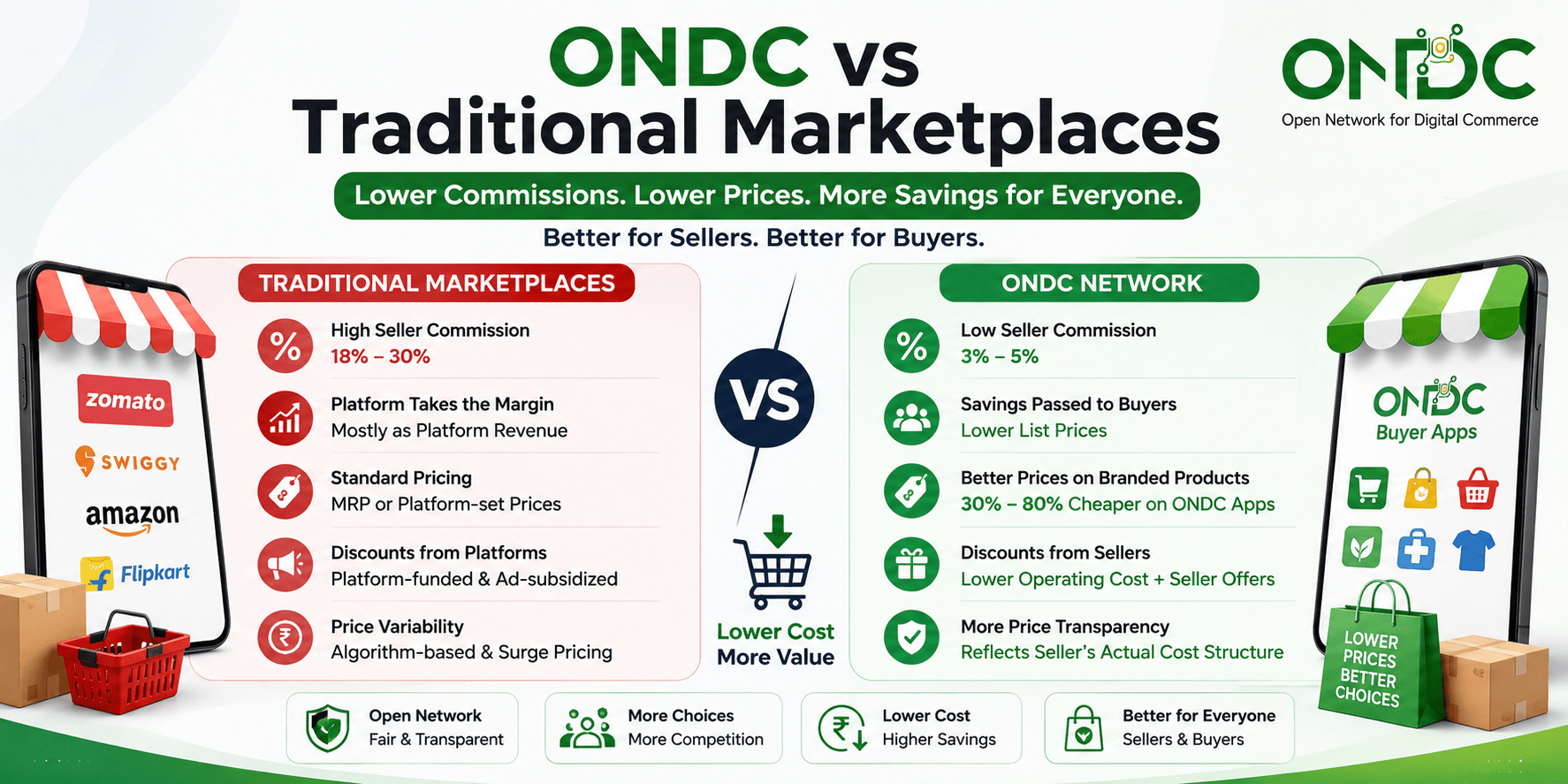
ONDC Discounts & Offers: How Buyers Save More Than on Traditional Marketplaces
Sounds like COSTBO might be the right choice for your business?
Get started by registering your business today! If you have any questions, we're here to help. Our team will reach out to you with detailed information about our offerings, product features, and a demo