

Top ONDC Platforms in India (2026)
Explore the top ONDC platforms in India (2026). Compare seller & buyer apps, commission rates (3–12%), 1200+ cities coverage, and 100M+ transactions.
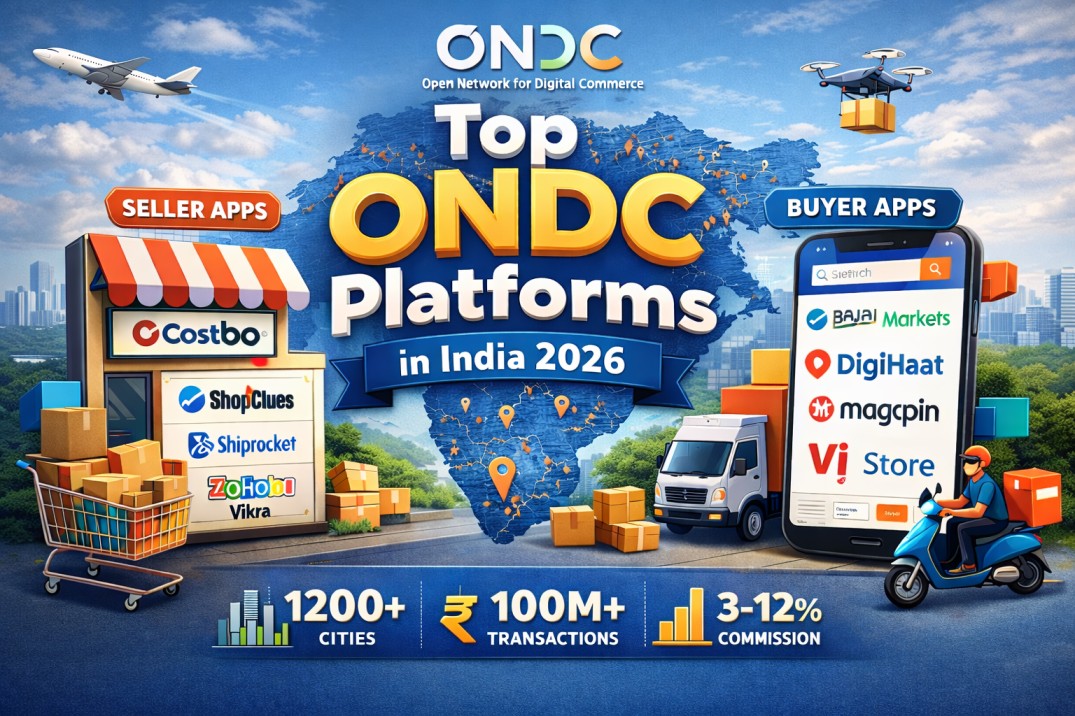
The Open Network for Digital Commerce (ONDC) is a Government of India-backed initiative launched to democratize digital commerce. Unlike closed marketplaces, ONDC works as an open protocol where:
- Seller apps onboard merchants.
- Buyer apps enable product discovery and order placement.
- Logistics and payment partners operate independently but interoperably.
As of 2026:
- 5+ lakh sellers are onboarded.
- 1200+ cities are operational.
- 100+ million cumulative transactions have been recorded.
- Grocery and Food & Beverage contribute over 50% of total orders.
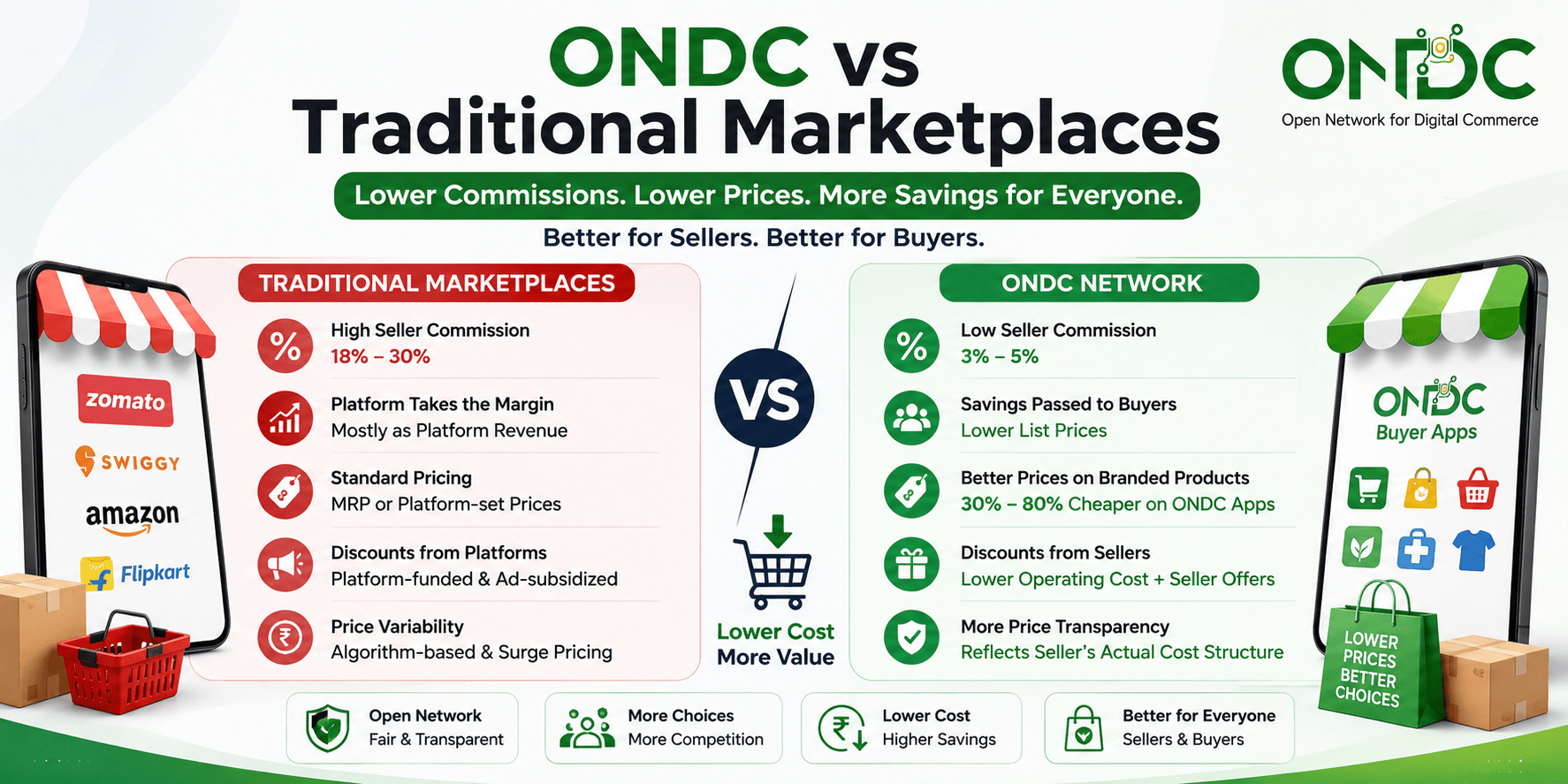
- Average seller commission ranges between 3%–12%, significantly lower than traditional marketplaces (15%–35%).
Below is a structured and detailed overview of the active ONDC Seller and Buyer Platforms you listed.
ONDC SELLER PLATFORMS (Seller Network Participants – SNPs)
1. Costbo
Costbo positions itself as a low-commission ONDC seller platform focused on profitability and margin retention.
Key Highlights:
- Commission: Approximately 3–4% (lower than many platforms charging 6–12%).
- Mobile device category commission: Around 1.5%.
- No heavy marketing fees.
- Competitive logistics pricing.
- GST-enabled onboarding and seller dashboard.
Strength:
Costbo focuses on reducing operational burden for sellers and improving net margins, especially in price-sensitive categories.
Best For:
- D2C brands.
- Electronics retailers.
- High-volume sellers aiming to increase ROI.
- Businesses migrating from high-commission marketplaces.
2. ShopClues
ShopClues is a value-commerce marketplace focused on Bharat (Tier 2 and Tier 3 cities). Its ONDC participation extends reach to SME sellers.
Key Strengths:
- Strong rural and semi-urban presence.
- Focus on affordable general merchandise.
- Established brand recall in value segment.
Category Focus:
- Electronics accessories.
- Fashion (budget segment).
- Home and utility products.
Best For:
Small and mid-sized sellers targeting price-conscious customers.
3. Mystore (mystore.in)
Mystore is a digital enablement platform that helps MSMEs create online stores and integrate with ONDC.
Key Features:
- Website creation + ONDC integration.
- Catalog and inventory management.
- Integrated payment systems.
- Assisted onboarding.
Strength:
It bridges the gap between offline retail and open-network commerce.
Best For:
- Traditional retailers going digital.
- MSMEs without prior eCommerce experience.
4. UdyamWell
UdyamWell focuses on MSME enablement aligned with government initiatives.
Key Highlights:
- Simplified merchant onboarding.
- MSME-focused infrastructure.
- ONDC protocol integration support.
Strength:
Ideal for first-time sellers who require structured onboarding support.
Best For:
- Small manufacturers.
- Government-registered MSMEs.
- Local businesses exploring digital expansion.
5. Shiprocket
Shiprocket is primarily a logistics enabler but also acts as an ONDC-integrated seller solution.
Key Data:
- 25+ courier partners.
- Coverage across 24,000+ pin codes.
- AI-driven courier recommendation system.
Strength:
Optimizes shipping cost and delivery timelines.
Best For:
- Sellers prioritizing logistics efficiency.
- Businesses shipping nationwide.
- High-volume D2C brands.
6. Vikra (by Zoho)
Vikra is an ONDC-enabled commerce solution built by Zoho.
Key Features:
- CRM and accounting integration.
- GST-ready billing.
- Inventory and order management.
- Enterprise-grade backend systems.
Strength:
Provides structured ERP-style ecosystem for organized businesses.
Best For:
- Mid-sized enterprises.
- Structured retail chains.
- Businesses requiring CRM + accounting integration.
7. ChattyBao Technologies Pvt Ltd
ChattyBao acts as a technology-driven ONDC seller network participant.
Focus Areas:
- Merchant digitization.
- API integration.
- Catalog onboarding support.
Best For:
Sellers who need backend integration assistance.
8. Easy Pay Pvt. Ltd.
Easy Pay participates in ONDC as a merchant enablement and payment-driven platform.
Strength:
- Assisted onboarding.
- Existing merchant base through payment ecosystem.
Best For:
Retailers already integrated into Easy Pay’s payment infrastructure.
9. Fynd
Fynd is an omnichannel retail technology platform integrated with ONDC.
Key Strengths:
- Fashion and lifestyle focus.
- Omnichannel retail integration.
- Enterprise retailer enablement.
Best For:
- Fashion brands.
- Large retail chains.
- Brands seeking online-offline synchronization.
10. Magicpin (Seller Side – Food & Beverage)
Magicpin plays a significant role in onboarding restaurants and grocery stores to ONDC.
Strength:
- Strong hyperlocal presence.
- Discount-led demand generation.
- Food delivery ecosystem participation.
Best For:
- Restaurants.
- Cloud kitchens.
- Grocery retailers.
11. NStore
NStore is a retail-tech company that integrates supermarkets and organized retailers with ONDC.
Key Strength:
- POS integration.
- Inventory synchronization.
- Supermarket enablement.
Best For:
- Organized retail chains.
- Large grocery stores.
12. Uengage (Food & Beverage Focus)
Uengage focuses on restaurant digitization and ONDC integration.
Key Strength:
- Restaurant technology solutions.
- Direct ordering ecosystem.
- Lower commission alternative to large food aggregators.
Best For:
- Restaurants looking to reduce aggregator commissions.
ONDC BUYER PLATFORMS (Buyer Network Participants – BNPs)
1. DigiHaat
DigiHaat is a major ONDC buyer platform focusing on local commerce.
Strength:
- Grocery and daily essentials.
- Local store discovery.
- MSME product visibility.
Best For:
Urban and semi-urban grocery shoppers.
2. HamaraMal
HamaraMal is a hyperlocal marketplace integrated with ONDC.
Focus:
- Community commerce.
- Local retail aggregation.
Best For:
Regional buyers preferring neighborhood sellers.
3. Bajaj Markets (by Bajaj Finserv Direct)
Bajaj Markets integrates fintech with commerce under the Bajaj Finserv ecosystem.
Strength:
- EMI-enabled purchases.
- Financial services integration.
- Trusted NBFC brand backing.
Best For:
Consumers seeking installment-based shopping.
4. Airpay
Airpay is a fintech-enabled commerce platform participating as a buyer app.
Strength:
- Payment integration.
- Merchant payment network leverage.
Best For:
Digitally active payment users.
5. Easy Pay (Buyer Platform)
Dual participation in ONDC ecosystem.
Strength:
- Assisted commerce model.
- Payment-linked customer base.
Best For:
Semi-urban and assisted digital shoppers.
6. Magicpin (Buyer Side – F&B Leader)
Magicpin is one of the most active buyer apps in ONDC’s food and grocery segment.
Strength:
- Restaurant discovery.
- Discount-driven model.
- Metro presence.
Best For:
Food delivery and hyperlocal grocery customers.
7. Mystore (Buyer Version)
Enables customers to discover MSME products via ONDC network.
Best For:
Buyers supporting small businesses.
8. Novopay
Novopay leverages fintech and assisted commerce.
Strength:
- Semi-urban focus.
- Financial network integration.
Best For:
Customers in emerging markets.
9. NStore (Buyer Integration)
Retail-focused buyer platform integrated with supermarket networks.
Best For:
Organized grocery shoppers.
10. Vi Store
The Vi telecom ecosystem has integrated ONDC commerce elements.
Strength:
- Large telecom user base.
- Digital services cross-leverage.
Best For:
Mobile-first consumers.
Strategic Ecosystem Insights
- Grocery and Food & Beverage dominate transaction volumes.
- Tier 2 and Tier 3 cities are driving growth.
- Commission structures remain significantly lower than traditional marketplaces.
- Logistics is open and interoperable, allowing sellers to optimize costs.
- Fintech-backed buyer apps are expanding through EMI and payment integration.
Final Conclusion
The ONDC ecosystem is evolving into a multi-platform open commerce network where:
- Seller platforms compete on commission and onboarding efficiency.
- Buyer apps compete on distribution and user base.
- Logistics providers compete on cost and service quality.
For sellers:
- Costbo offers strong margin advantage.
- Shiprocket optimizes logistics.
- Zoho Vikra supports structured enterprise sellers.
- Magicpin and Uengage are strong in Food & Beverage.
For buyers:
- DigiHaat and Magicpin dominate grocery and hyperlocal.
- Bajaj Markets adds EMI-driven purchasing.
- Vi Store and fintech apps expand digital reach.
As ONDC scales beyond 100 million transactions and continues city expansion, early adoption on the right platform can significantly impact seller profitability and digital growth in 2026 and beyond.
Frequently Asked Questions (FAQ) – ONDC Platforms (2026)
1. What is ONDC?
ONDC (Open Network for Digital Commerce) is a Government of India-backed open commerce network that enables buyers and sellers to transact through interoperable apps instead of closed marketplaces.
2. How is ONDC different from Amazon or Flipkart?
Traditional marketplaces are closed ecosystems where sellers must operate within a single platform’s rules, logistics, and commission structure. ONDC is an open protocol where:
- Sellers can choose their seller app.
- Buyers can purchase from multiple apps.
- Logistics providers are interoperable.
- Commission is generally lower (3%–12%).
3. What is the average commission on ONDC?
Most ONDC seller platforms charge between 3% to 12%, depending on category. Some platforms offer even lower commission in specific categories like electronics or mobile devices.
4. How many sellers are on ONDC?
As of 2026, ONDC has onboarded over 5 lakh sellers across India.
5. Which categories perform best on ONDC?
Top performing categories include:
- Grocery
- Food & Beverage
- Fashion
- Electronics
- Home essentials
Grocery and F&B contribute to more than 50% of total transactions.
6. Can small businesses join ONDC?
Yes. ONDC is specifically designed to empower:
- MSMEs
- Kirana stores
- Restaurants
- D2C brands
- Local retailers
Many seller platforms provide assisted onboarding and GST integration.
7. Do sellers need their own website to sell on ONDC?
No. Sellers can onboard through an ONDC seller platform, which handles cataloging, order management, and integration.
8. Is logistics mandatory from one provider?
No. ONDC allows open logistics integration. Sellers can choose from multiple logistics partners based on cost, speed, and coverage.
9. Are buyer apps and seller apps different?
Yes.
- Seller apps onboard merchants and manage inventory.
- Buyer apps allow customers to discover and order products.
Both are connected through ONDC protocol.
10. Is ONDC suitable for large enterprises?
Yes. Enterprise-ready platforms offer CRM, ERP, and accounting integrations suitable for mid-sized and large organizations.
References
- Government of India – Department for Promotion of Industry and Internal Trade (DPIIT)
ONDC Official Website – Network Policy and Operational Guidelines- Public transaction updates released by ONDC Network
Read More
- Building Blocks of ONDC: A Detailed Guide to India’s Open Digital Commerce Infrastructure
- ONDC A Revolutionary Open eCommerce Network – in Action
- Roles of Seller App & Buyer App on ONDC Network
- Why Sell Online Through the ONDC Network?
- Getting Started as a Seller on ONDC: Registration Options
- Which Is the Best ONDC Seller App? Features, Pros & Cons (2026)
- Best ONDC Buyer Apps in 2026: Features, Pros & Cons
Related post
.png)
ONDC Buyer App vs Amazon/Flipkart App: What's Actually Different for Shoppers
ONDC Discounts & Offers: How Buyers Save More Than on Traditional Marketplaces
.png)
Top ONDC Network Buyer Apps to Use in 2026

Sounds like COSTBO might be the right choice for your business?
Get started by registering your business today! If you have any questions, we're here to help. Our team will reach out to you with detailed information about our offerings, product features, and a demo