

Top 30 Online Marketplaces in India (2026 Edition)
Discover the top 30 online marketplaces in India (2026), including Amazon, Flipkart, IndiaMART & ONDC. Compare B2C and B2B platforms for sellers.

Best B2C & B2B Ecommerce Platforms + ONDC Explained in Detail
India’s ecommerce industry is growing at an unprecedented pace. As of 2026, India’s digital commerce market is estimated to cross $120–130 billion, growing at a CAGR of 20%+. Over 900 million internet users, rapid UPI adoption, ONDC expansion, and smartphone penetration above 75% in urban India have transformed how Indians shop and sell.
More than 1.2 million sellers actively sell across marketplaces like Amazon, Flipkart, Meesho, and B2B platforms like IndiaMART and Udaan.
But choosing the right marketplace depends on:
- Your product category
- Your target audience (urban vs rural)
- Your pricing model
- Your logistics capability
- Your margin structure
This guide covers:
- 20+ major B2C marketplaces
- 8+ leading B2B platforms
- A detailed ONDC section
- Strategic insights
- Detailed FAQ
1. Amazon India
Amazon India is one of the largest ecommerce platforms in India with pan-India coverage and access to global infrastructure.
Data Points:
- 300+ million registered Indian customers
- 100+ fulfillment centers
- 50%+ ecommerce market share in India
- Prime membership base exceeding 20 million
Strengths:
- Fulfilled by Amazon (FBA)
- Prime 1–2 day delivery
- Advanced ad platform (Amazon PPC)
- Global selling opportunity
Seller Economics:
Commission: 8–20%
FBA fees extra
Advertising often required (10–30% of revenue)
Best For:
Electronics, private labels, fashion, books, consumer goods.
Amazon offers unmatched scale but requires strong margin planning.
2. Flipkart
Founded in 2007, Flipkart remains India’s strongest homegrown competitor to Amazon.
Data Points:
- 400+ million registered users
- Strong Tier 2 & 3 market penetration
- Flipkart Plus loyalty program
Strengths:
- Big Billion Days sale dominance
- Deep logistics reach
- Regional language support
Seller Model:
Commission-based
Advertising tools available
Best For:
Electronics, mobile phones, appliances, fashion.
Flipkart performs extremely well in semi-urban markets.
3. Meesho
Meesho pioneered social commerce in India.
Data Points:
- 100+ million app downloads
- 0% commission in most categories
- Strong presence in Tier 2 & 3 cities
Unique Model:
Sellers share products via WhatsApp & Facebook.
Platform earns through logistics margins.
Best For:
Low-cost fashion
Home goods
Budget lifestyle products
Meesho is ideal for new sellers with low capital.
4. Snapdeal
Snapdeal focuses on affordable products.
Data Points:
- Strong rural and Tier 3 reach
- Value-focused catalog
Best For:
Low-cost electronics
Budget fashion
Affordable accessories
Snapdeal works best for sellers targeting price-sensitive buyers.
5. Myntra
India’s largest fashion-focused ecommerce platform.
Data Points:
- 60+ million active users
- Fashion-first brand positioning
- Try & Buy feature
Strengths:
Premium fashion ecosystem
Strong brand collaborations
Best For:
Apparel brands
Footwear
Lifestyle labels
Higher brand positioning compared to mass marketplaces.
6. Ajio
Owned by Reliance Retail, Ajio blends global and indie fashion.
Data Points:
- Ajio Luxe premium segment
- Backed by Reliance supply chain
Best For:
Premium fashion
Designer brands
Urban consumers
7. Nykaa
India’s largest beauty and wellness marketplace.
Data Points:
- 20+ million active customers
- Strong private label portfolio
- 150+ offline stores
Unique Advantage:
Beauty-focused ecosystem
High repeat purchase category
Best For:
Skincare brands
Makeup labels
Haircare manufacturers
Beauty margins (40–70%) make Nykaa attractive.
8. Tata CLiQ
Tata’s omnichannel ecommerce platform.
Data Points:
- Integrated with Tata retail ecosystem
- Store pickup options
Best For:
Electronics
Premium fashion
JioMart benefits from Reliance’s logistics and backend distribution efficiency, reducing last-mile challenges. It focuses heavily on value pricing and bulk buying offers.
Best For:
- FMCG brands
- Household essentials
- Local distributors
JioMart is strategically strong for sellers who want deep penetration across semi-urban and rural India.
11. Paytm Mall
Paytm Mall integrates ecommerce with Paytm’s digital wallet ecosystem, which has over 300 million users. It focuses on cashback-driven sales and mobile-first buyers.
Key Data Points:
- Strong digital payments integration
- Cashback & wallet incentives boost conversions
- Popular among mobile-first consumers
The platform operates on a commission-based model with advertising options for sellers. It works best in categories where discounting and cashback influence purchase decisions.
Best For:
- Electronics sellers
- Lifestyle products
- Accessories & gadgets
Paytm Mall is suitable for sellers who can leverage wallet promotions and discount-led acquisition strategies.
12. ShopClues
ShopClues positions itself as a value-focused ecommerce marketplace targeting price-sensitive customers in Tier 2 and Tier 3 cities.
Key Data Points:
- Factory-price positioning
- Strong rural and non-metro customer base
- Commission-based seller model
Compared to Amazon and Flipkart, competition may be lower in certain categories. However, margins are typically thin.
Best For:
- Budget electronics
- Affordable fashion
- Low-cost home products
ShopClues works best for sellers operating on high volume and cost-efficient sourcing.
13. Reliance Digital
Reliance Digital is one of India’s largest electronics retail chains with strong online-offline integration. It benefits from Reliance Retail’s national presence.
Key Data Points:
- Strong EMI and financing ecosystem
- Nationwide retail touchpoints
- Service and installation support
Unlike pure marketplaces, Reliance Digital focuses on brand-led electronics and appliances.
Best For:
- Consumer electronics brands
- Large appliances
- Smart home devices
Ideal for sellers requiring after-sales service and offline brand presence.
14. Croma
Croma, part of the Tata Group, operates over 300 stores nationwide and integrates ecommerce with offline support.
Key Data Points:
- Premium electronics positioning
- Warranty-backed purchases
- In-store pickup and consultation
Croma emphasizes product expertise and after-sales service rather than heavy discounting.
Best For:
- Premium electronics brands
- Appliance manufacturers
Croma is ideal for sellers targeting urban, quality-conscious buyers.
15. FirstCry
FirstCry is India’s largest baby and kids products marketplace, serving 25+ million registered parents and operating 400+ offline stores.
Key Data Points:
- High repeat purchase rate
- Focused niche audience
- Trusted parenting ecosystem
It offers baby apparel, toys, feeding accessories, hygiene products, and maternity items.
Best For:
- Baby clothing brands
- Toy manufacturers
- Childcare product suppliers
FirstCry is powerful for brands seeking a focused and loyal parent community.
16. Pepperfry
Pepperfry specializes in furniture and home décor and operates over 200 Studio Pepperfry outlets for offline product trials.
Key Data Points:
- AR visualization features
- Strong metro presence
- Installation services included
Furniture is a high-ticket category with lower purchase frequency but higher order value.
Best For:
- Furniture manufacturers
- Home décor brands
- Interior designers
Pepperfry works well for mid-to-premium home brands targeting urban buyers.
17. Limeroad
Limeroad is a fashion-focused marketplace emphasizing curated lookbooks and visual styling inspiration.
Key Data Points:
- Women-focused audience
- Boutique fashion positioning
- Content-driven commerce
It allows smaller fashion brands to showcase curated collections rather than compete purely on price.
Best For:
- Ethnic wear brands
- Boutique labels
- Women’s apparel sellers
Limeroad suits niche fashion sellers seeking discovery-based engagement.
18. Craftsvilla
Craftsvilla focuses on ethnic and handmade Indian products, empowering artisans and small sellers.
Key Data Points:
- Strong saree & jewelry presence
- Artisan-focused platform
- Tier 2 & 3 penetration
It provides visibility to traditional fashion sellers.
Best For:
- Handloom saree sellers
- Ethnic jewelry brands
- Artisan handicraft businesses
Craftsvilla is ideal for culturally rooted fashion categories.
19. OLX
OLX is a peer-to-peer classifieds platform focused on resale markets.
Key Data Points:
- Popular for vehicles, electronics, furniture
- Free listings
- Direct buyer-seller negotiation
It does not operate as a structured marketplace but as a classified ad platform.
Best For:
- Used goods sellers
- Individual resellers
- Local traders
OLX works best for second-hand or pre-owned items.
20. Facebook Marketplace
Facebook Marketplace allows users to list products for free within their social network.
Key Data Points:
- Community-driven trust
- Localized selling
- No formal commission in most cases
It works well for hyperlocal transactions and resale.
Best For:
- Furniture resale
- Local electronics
- Community-based sellers
Ideal for small-scale, local commerce.
21. Blinkit
Blinkit (formerly Grofers) is a quick-commerce platform promising 10–20 minute grocery delivery in major metros.
Key Data Points:
- Dark-store logistics
- High-frequency orders
- Urban millennial audience
Inventory-led model, not open marketplace.
Best For:
- FMCG brands
- Packaged snacks
- Ready-to-eat food products
Blinkit is suitable for brands targeting urban convenience buyers.
22. Zepto
Zepto is an app-only quick-commerce startup operating in major cities.
Key Data Points:
- Ultra-fast delivery model
- Young urban consumer base
- Micro-warehouse infrastructure
It works on inventory-led operations.
Best For:
- Grocery brands
- Instant consumption products
Zepto suits brands targeting fast-moving consumer goods.
23. IndiaMART
IndiaMART is India’s largest B2B marketplace.
Key Data Points:
- 150+ million buyers
- 7+ million suppliers
- Subscription-based model
It connects manufacturers, wholesalers, and exporters with bulk buyers.
Best For:
- Industrial manufacturers
- Exporters
- Bulk suppliers
IndiaMART is ideal for large-order B2B transactions.
24. Udaan
Udaan connects wholesalers with retailers across 900+ cities.
Key Data Points:
- 3M+ retailers
- Embedded credit facilities
- Strong FMCG distribution
It supports working capital credit, improving retailer purchase cycles.
Best For:
- FMCG brands
- Staple distributors
- Kirana suppliers
Udaan is powerful for scaling retail distribution.
25. TradeIndia
TradeIndia is an export-focused B2B portal.
Key Data Points:
- Strong machinery & industrial presence
- Inquiry-based selling model
- Annual subscription plans
Best For:
- Industrial equipment suppliers
- Manufacturing exporters
TradeIndia works well for high-ticket B2B deals.
26. Alibaba
Alibaba is a global B2B platform used by Indian exporters.
Key Data Points:
- International buyer access
- Bulk export transactions
- Membership-based model
Best For:
- Export-oriented manufacturers
- Large-scale suppliers
Alibaba supports cross-border trade expansion.
27. Moglix
Moglix is a B2B industrial supply platform focusing on MRO (maintenance, repair, and operations).
Key Data Points:
- Enterprise procurement model
- Industrial supply chain integration
- Corporate client base
Best For:
- Industrial suppliers
- Hardware manufacturers
Moglix serves enterprise-level buyers.
28. Justdial
Justdial is India’s local search and business directory platform.
Key Data Points:
- Millions of SME listings
- Lead-generation model
- Strong regional presence
It generates B2B leads rather than direct ecommerce transactions.
Best For:
- Local service providers
- Small manufacturers
- Regional distributors
Justdial is ideal for businesses seeking inquiry-based lead generation.
29. ONDC (Open Network for Digital Commerce)
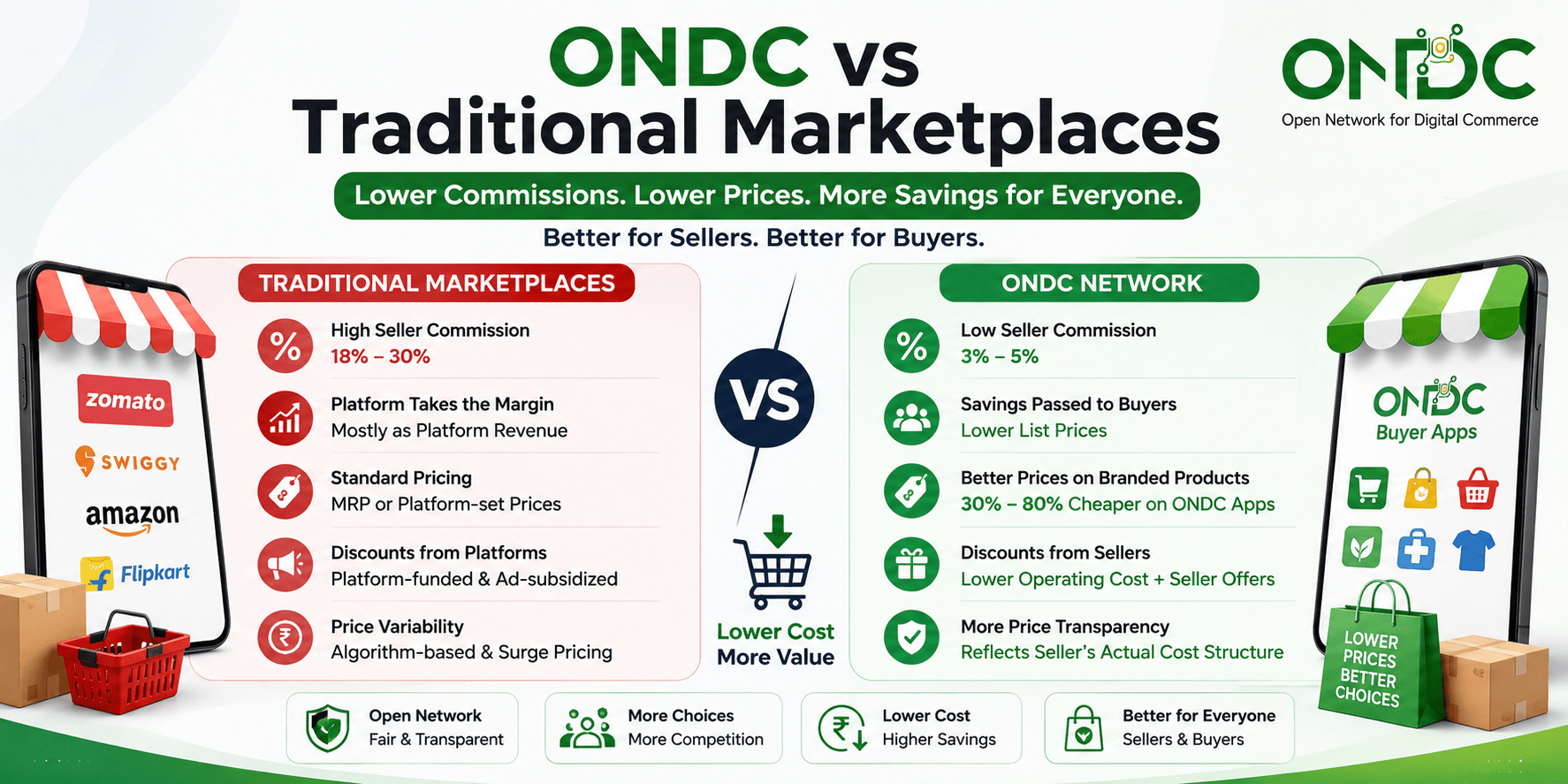
ONDC is not a marketplace but an open network connecting buyer apps, seller apps, logistics providers, and payment systems.
Data Points (2026)
- 12+ ONDC buyer apps
- 10+ ONDC seller apps
- 1200+ cities coverage
- Commission: 3–8%
ONDC reduces platform monopoly and enables MSMEs. It allows sellers to be discoverable across multiple buyer apps instead of being locked into one marketplace. It is still growing but strategically important for long-term cost efficiency and ecosystem decentralization.
1. Which is the best online selling platform in India in 2026?
There is no universal best platform.
Amazon and Flipkart offer traffic.
Nykaa dominates beauty.
IndiaMART is best for B2B.
Shopify offers ownership.
ONDC offers lower commission and open structure.
2. Is Amazon better than Flipkart?
Amazon is stronger in premium categories and metro markets.
Flipkart is stronger in Tier 2 & 3 markets and mobiles.
3. Is Nykaa better than Amazon for beauty brands?
Yes. Nykaa offers premium positioning, lower return rates, and stronger beauty-focused audience.
4. Is IndiaMART suitable for small retail sellers?
Not ideal. It works best for manufacturers and bulk suppliers.
5. How much gross margin should I keep for marketplace selling?
At least 40–50% gross margin is recommended to survive fees and returns.
ONDC-Specific FAQs
6. What is ONDC and how is it different from Amazon?
ONDC is an open network, not a single marketplace.
Amazon is a centralized platform.
ONDC connects multiple buyer and seller apps through one open infrastructure.
7. Is ONDC cheaper than Amazon?
Generally yes.
Commission on ONDC typically ranges from 3–8%, lower than Amazon’s 15% average referral fee.
However, logistics and app-specific fees may vary.
8. Should I start selling on ONDC in 2026?
Yes — especially if:
- You want lower commission
- You are an MSME
- You sell locally
- You want early-mover advantage
ONDC is still developing, so combining it with marketplaces is ideal.
9. Can I sell on Amazon and ONDC together?
Yes. Many sellers use:
Amazon for traffic
ONDC for lower-cost distribution
Shopify for customer ownership
References
- IBEF Ecommerce Report 2026
- RedSeer India Ecommerce Outlook
- RBI UPI Reports
- Company Annual Reports (Nykaa, IndiaMART, Amazon)
- Government ONDC Updates
Read More
- Building Blocks of ONDC: A Detailed Guide to India’s Open Digital Commerce Infrastructure
- ONDC A Revolutionary Open eCommerce Network – in Action
- Roles of Seller App & Buyer App on ONDC Network
- Why Sell Online Through the ONDC Network?
- Getting Started as a Seller on ONDC: Registration Options
- Which Is the Best ONDC Seller App? Features, Pros & Cons (2026)
- Best ONDC Buyer Apps in 2026: Features, Pros & Cons
Related post
.png)
How Multiple Buyer Apps Access the Same Sellers on ONDC (Network Effect Explained Simply)
.png)
ONDC Buyer App vs Amazon/Flipkart App: What's Actually Different for Shoppers
ONDC Discounts & Offers: How Buyers Save More Than on Traditional Marketplaces
.png)
Top ONDC Network Buyer Apps to Use in 2026
Sounds like COSTBO might be the right choice for your business?
Get started by registering your business today! If you have any questions, we're here to help. Our team will reach out to you with detailed information about our offerings, product features, and a demo