

Quick Commerce vs Traditional ONDC Fulfillment: Which Model Fits Your Business?
Compare quick commerce and traditional ONDC fulfillment, including delivery speed, inventory, costs, returns, geographic reach, and operational complexity.
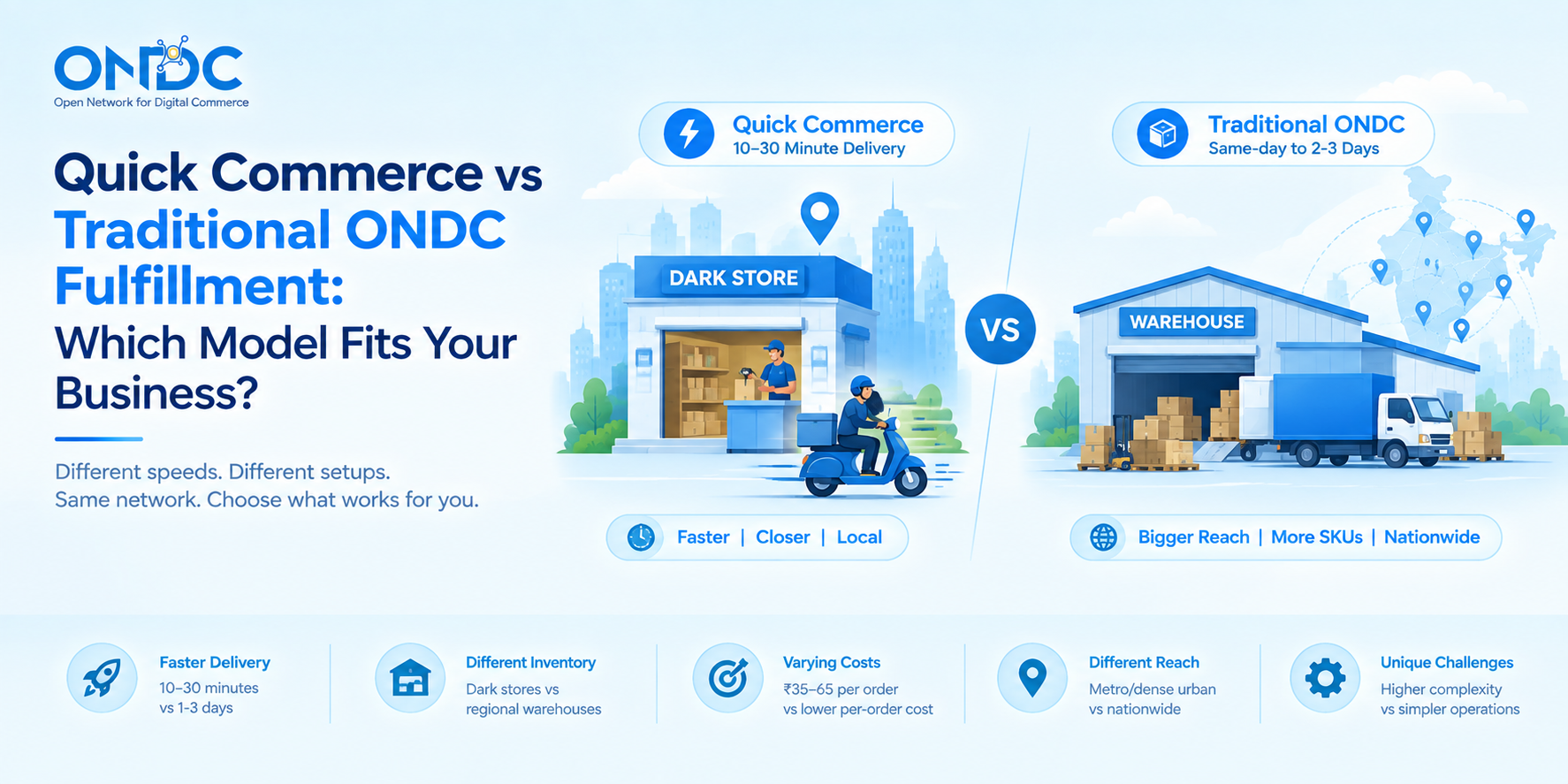
Quick Answer
Quick commerce fulfillment (10-30 minute delivery from dense, hyperlocal dark stores) fits sellers with high-frequency, low-consideration products like groceries and daily essentials in metro cities, where speed drives repeat purchases. Traditional ONDC fulfillment (same-day to 2-3 day delivery from regional warehouses) fits sellers with broader SKU ranges, nationwide reach needs, or products where buyers are willing to wait — including most fashion, electronics, and specialty categories. Most growing sellers eventually run both models side by side rather than choosing permanently.
"Should I set up for quick commerce or stick with standard fulfillment?" is one of the more consequential operational decisions a seller on ONDC will make — it shapes warehouse strategy, SKU selection, and cost structure very differently depending on which way you lean. The honest answer is that it's rarely all-or-nothing, but understanding the real tradeoffs first will save you from over-investing in the wrong model. This is where multi-warehouse planning and fulfillment strategy actually start.
The Numbers: Two Genuinely Different Businesses
A few data points that show just how differently these two models operate:
- India's quick commerce market was valued at roughly USD 3.65 billion in 2026 and is projected to double by 2031, with quick commerce alone potentially reaching USD 50 billion by 2030 as India's broader e-commerce market approaches USD 250 billion
- Quick commerce return rates run notably lower than traditional e-commerce — roughly 2-5%, compared to 15-25% for standard fulfillment — largely because instant delivery reduces the "changed my mind" and "took too long" return triggers common in multi-day shipping
- Running your own quick commerce fulfillment typically costs ₹35-65 per order in last-mile delivery alone, before accounting for dark store rent, staffing, and inventory carrying costs — a materially different cost structure than standard warehouse-to-doorstep shipping
- Despite the quick commerce boom, traditional distribution still moves an estimated 90% of India's FMCG volume nationally — quick commerce is a fast-growing layer on top of the existing system, not a wholesale replacement for it
How Quick Commerce Fulfillment Actually Works
- Inventory lives in dark stores — compact, hyperlocal fulfillment centers typically 1,500-5,000 sq ft, stocking 2,000-8,000 high-velocity SKUs, placed every 2-4 km across dense urban neighborhoods
- Orders are picked, packed, and handed to a delivery rider within minutes, with the full order-to-doorstep cycle typically staying under 20-30 minutes in metro cities
- Because dark stores are small and dense, this model depends heavily on accurate, location-specific inventory management — a fast-moving SKU running out at one dark store can't simply be covered by a distant central warehouse the way it could in traditional fulfillment
- Reach is inherently limited to areas with dark store coverage — if your target buyers are outside metro and dense urban zones, quick commerce infrastructure often doesn't reach them yet
How Traditional ONDC Fulfillment Actually Works
- Inventory is held in larger regional or central warehouses, covering broader SKU ranges without the same tight space constraints as a dark store
- Delivery timelines run same-day to 2-3 days depending on distance from the fulfilling warehouse and the logistics partner used
- This model supports far broader geographic reach — sellers can ship nationwide through standard logistics partners integrated with ONDC, rather than being limited to wherever dark store infrastructure exists
- Return rates run higher, and reverse logistics timelines are longer, but the overall system carries more buffer time and is generally simpler to operate at lower per-order complexity
Quick Commerce vs Traditional ONDC Fulfillment — At a Glance
Which Model Fits Which Business
- Quick commerce fits best: grocery, daily essentials, personal care, and other high-frequency, low-consideration purchases in metro or dense urban markets, where buyers value speed over selection and repeat purchase behavior rewards fast delivery
- Traditional fulfillment fits best: fashion, electronics, health & wellness, home goods, and other categories where buyers are willing to wait, product consideration is higher, and nationwide reach matters more than 20-minute delivery
- Hybrid fits best: growing sellers with a metro-heavy customer base and daily-essential SKUs alongside a broader catalog — running quick commerce for the fast-moving subset while keeping traditional fulfillment for everything else
Questions to Ask Before Choosing
- Is my target customer base concentrated in metro/dense urban areas, or spread more broadly across the country?
- Are my products high-frequency and low-consideration (groceries, daily essentials) or higher-consideration purchases (fashion, electronics) where buyers don't mind waiting a day or two?
- Can I absorb the higher operational complexity and per-order cost of dark store fulfillment, or does my margin structure favor the simpler, lower-complexity traditional model?
- Do I have (or can I build) the multi-warehouse inventory visibility needed to run dense, location-specific stock accurately, or would that stretch operations too thin right now?
Frequently Asked Questions
Can I run both quick commerce and traditional fulfillment on ONDC at the same time?
Yes — many growing sellers run a hybrid model, using quick commerce for their fastest-moving, high-frequency SKUs in metro areas while relying on traditional fulfillment for their broader catalog and wider geographic reach.
Is quick commerce more expensive to run than traditional fulfillment?
Generally yes, on a per-order basis — last-mile delivery alone typically runs ₹35-65 per order, plus dark store rent and staffing — but it's frequently offset by higher order frequency and lower return rates in the categories it suits best.
Does quick commerce work outside major metro cities?
Coverage is expanding into Tier 2 cities, but dark store economics in lower-density markets remain less proven, so traditional fulfillment currently offers more reliable reach outside major metros.
Which model has lower returns — quick commerce or traditional fulfillment?
Quick commerce, generally — return rates run around 2-5% compared to 15-25% for traditional e-commerce, largely because fast delivery reduces the wait-driven reasons buyers change their mind.
Should a new ONDC seller start with quick commerce or traditional fulfillment?
Most new sellers start with traditional fulfillment, since it's operationally simpler and doesn't require dark store investment, then add quick commerce selectively once they've identified fast-moving SKUs and a concentrated metro customer base worth the added complexity.
Building the Right Fulfillment Mix
The fastest-growing sellers on ONDC generally don't pick one model and stop — they start with whichever fits their current stage, then layer in the other as their catalog and customer base justify it. A platform like COSTBO supports both, syncing inventory across dark stores and traditional warehouses from one dashboard so the decision doesn't have to be permanent.
About Costbo
Founded by Mr. Eswar and Mr. Ananth, with nearly 20 years of technology experience, Costbo is a leading ONDC seller platform powering India’s open digital commerce ecosystem. Costbo is among the first ONDC 1.2.0 certified seller platforms, enabling brands and sellers to sell on ONDC with fast onboarding, lower costs, and full operational control.
Ready to grow on ONDC? Start your journey with Costbo today.
References
• Quick Commerce for D2C Brands: The Complete Guide (2026) — Base
• Can existing retail stores challenge dark stores in quick-commerce race?
• Quick Commerce vs Traditional Distribution FMCG India — Brand Chanakya
• Dark Store vs Micro-Fulfillment: D2C Guide 2026 — DAAKit
Read More
- Building Blocks of ONDC: A Detailed Guide to India’s Open Digital Commerce Infrastructure
- ONDC A Revolutionary Open eCommerce Network – in Action
- Roles of Seller App & Buyer App on ONDC Network
- Why Sell Online Through the ONDC Network?
- Getting Started as a Seller on ONDC: Registration Options
- Which Is the Best ONDC Seller App? Features, Pros & Cons (2026)
- Best ONDC Buyer Apps in 2026: Features, Pros & Cons
- What is ONDC Buyer App
Related post
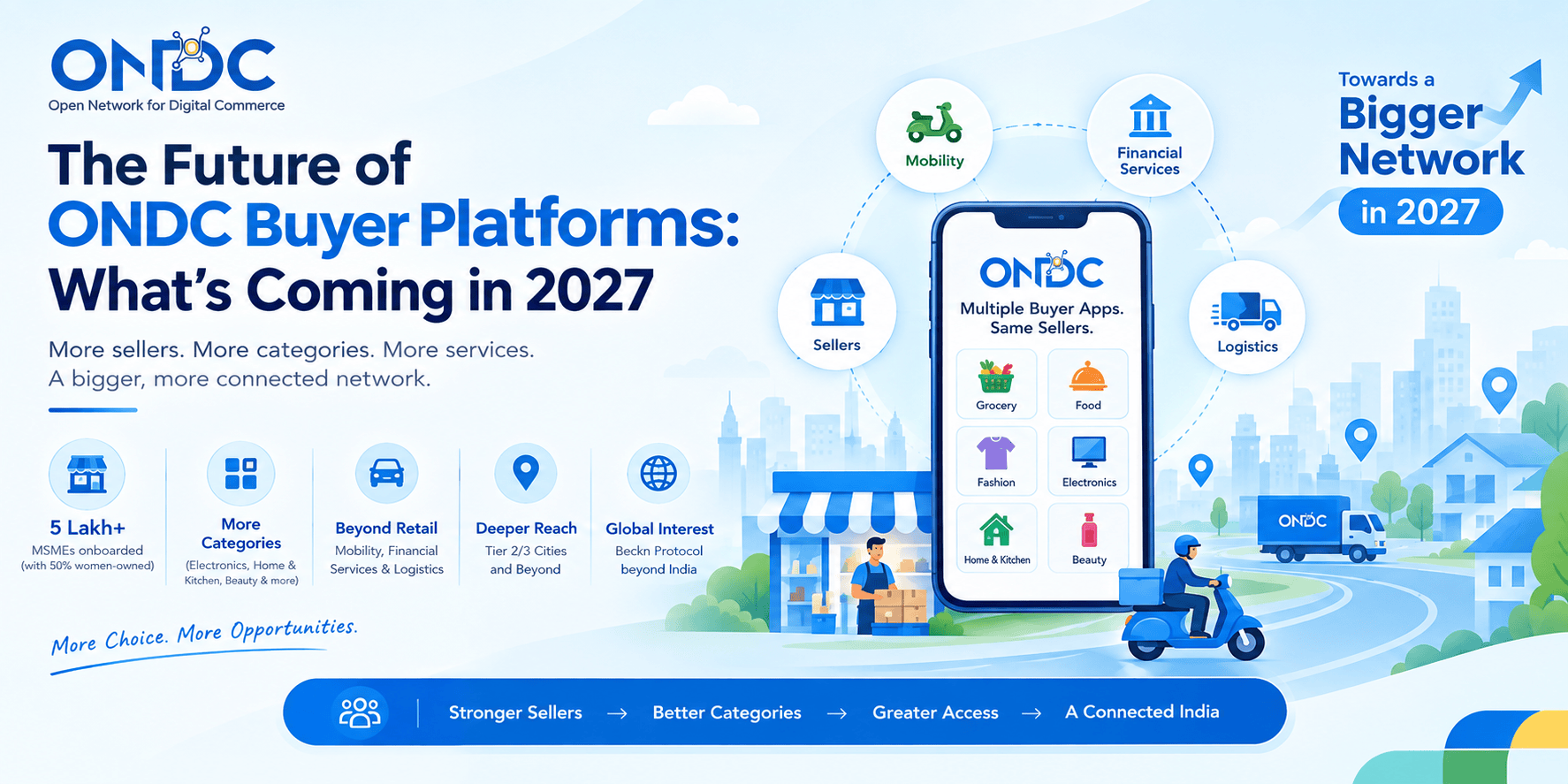
Future of ONDC Buyer Platforms: What's Coming in 2027
.png)
How Logistics & Delivery Partners Plug Into ONDC Buyer Platforms
.png)
.png)
How Multiple Buyer Apps Access the Same Sellers on ONDC (Network Effect Explained Simply)
Sounds like COSTBO might be the right choice for your business?
Get started by registering your business today! If you have any questions, we're here to help. Our team will reach out to you with detailed information about our offerings, product features, and a demo